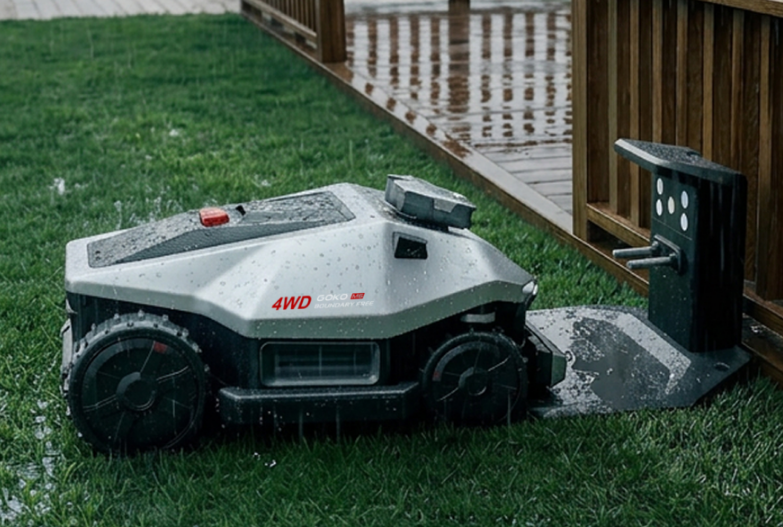
Rain is the one variable no lawn schedule survives. You can plan around grass growth rate, blade sharpness, and time of day — but a Tuesday-afternoon thunderstorm doesn’t check your calendar. For a machine that mows unattended, the ability to notice water and act on it is not a convenience feature. It’s the difference between a healthy lawn and a rutted, torn, disease-prone one.
This article opens up the black box. What is a rain sensor actually sensing? Why does wet grass matter agronomically? And how does a modern robotic lawn mower with rain sensor hardware translate a few droplets into a decision to abandon a task and drive home?
Part 1: Why Wet Grass Is a Bad Idea to Cut
Before the electronics, the agronomy. Mowing saturated turf causes four distinct problems.
The cut degrades. Wet grass blades lie flat and slick. A rotating blade pushes them over instead of severing them cleanly, then they spring back uncut. What you get is a ragged, uneven surface — and the torn tissue at the tip is a wound, not a cut.
Clippings clump. Damp clippings mat together instead of dispersing, forming wet blankets on the lawn that smother the turf beneath and eventually kill it. They also pack into the deck and around the blade housing.
Disease spreads. Fungal pathogens — brown patch, dollar spot, pythium — move on moisture. A mower crossing an infected wet patch picks up spores on its wheels and deck and distributes them across the entire lawn.
Soil compacts. Wet ground has almost no bearing strength. Wheels sink, leave ruts, and squeeze air out of the root zone. Compacted soil chokes root respiration and takes months to recover.
An autonomous lawn mower that ignores weather doesn’t just risk itself. It risks the lawn.
Part 2: How Rain Sensors Actually Work
There are three common approaches in outdoor robotics, and they differ meaningfully.
Conductive (resistive) sensing
The simplest method. Two interlocking metal traces sit on a small exposed board, separated by a gap. Dry air is a poor conductor, so resistance across the gap is effectively infinite. When water bridges the traces, resistance collapses and current flows. The controller sees the drop and flags “wet.”
Strengths: cheap, instant, unambiguous. Weaknesses: the traces are exposed, so they oxidize, and dew, sprinkler mist, or morning fog trigger them as readily as rain. They also stay wet — and therefore keep reporting rain — long after the sky has cleared, unless a heater or drying-delay timer is used.
Capacitive sensing
The sensing element sits behind a sealed dielectric surface. It measures the capacitance of the space above it. Water has a dielectric constant of roughly 80 versus air’s 1, so even a thin film of moisture produces a large, easily detected shift in capacitance.
Strengths: no exposed metal, no corrosion, sensitivity is tunable — you can set a threshold that distinguishes a light dew film from a genuine downpour. Weaknesses: more expensive, requires calibration, and can drift with temperature.
Optical (infrared) sensing
An IR emitter fires a beam into a transparent surface at an angle chosen so the light totally internally reflects back to a photodiode. Dry surface: full reflection, strong signal. A water droplet on the outside changes the refractive index at the boundary, letting light escape. Signal drops. This is the technology in automotive automatic wipers.
Strengths: fully sealed, immune to contamination on the sensing traces, proportional output (droplet size and rate are inferable). Weaknesses: costliest, needs a clean optical window.
Part 3: The Sensor Is Only Half the System
Here’s what separates a genuinely smart lawn mower from one with a rain switch: a bare sensor is reactive. It only knows the rain that has already landed on it. By the time it fires, the mower is already several hundred feet from the dock, on wet grass, and cutting.
Modern systems layer three inputs:
- Onboard detection — the physical sensor, for immediate ground truth.
- Connected weather monitoring — forecast and radar data pulled over Wi-Fi or 4G, giving the mower a predictive horizon rather than a reactive trigger.
- Task-state logic — how far from the dock is the mower, how much battery remains, what percentage of the zone is complete, and is this a passing sprinkle or a front moving in?
Combine them and the machine can make a decision before the first drop lands.
Part 4: Inside the GOKO M6’s Rain Response
The GOKO M6 implements this as an integrated Rain Detection & Weather Adaptation system: it monitors changing weather conditions and returns to its charging station when conditions worsen. In practice the chain runs like this.
Detect. Onboard rain detection registers moisture. In parallel, the M6’s always-on connectivity — 4G, Wi-Fi, and Bluetooth — keeps it aware of deteriorating conditions rather than waiting to be rained on.
Decide. The mower evaluates the task in progress against conditions and battery state, then suspends mowing.
Retreat. CyberNav™ Fusion Navigation takes over the route home. This is where the fusion architecture matters: rain degrades visibility for cameras and can attenuate satellite signal under cloud and canopy. Because the M6 blends RTK, nRTK, VSLAM visual navigation, an IMU, and wheel odometry, losing confidence in one input doesn’t strand the machine. It navigates back and auto-docks for recharging.
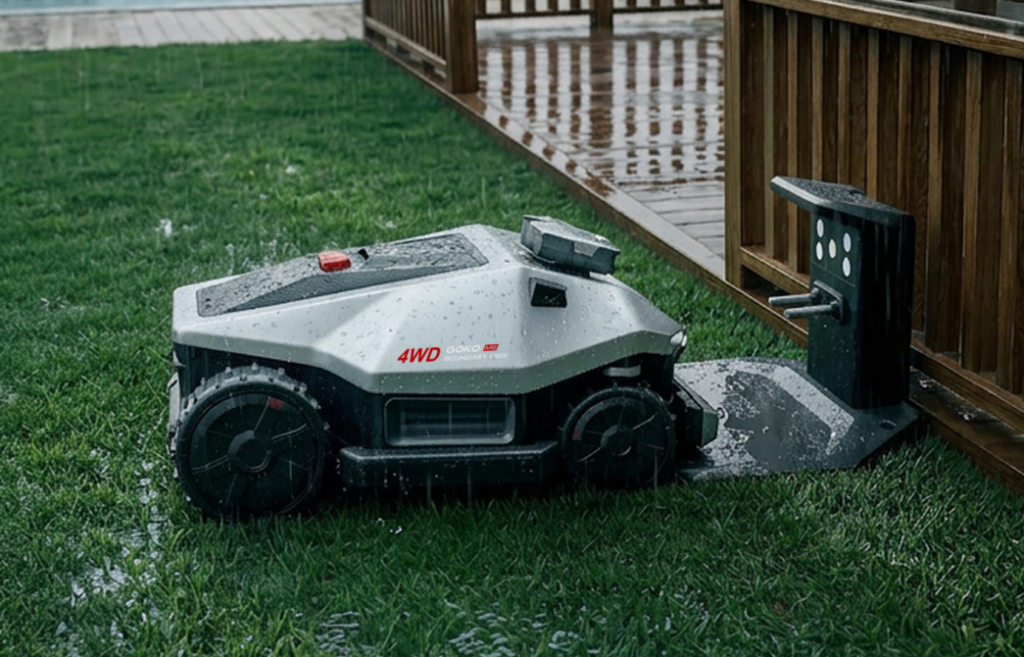
Endure. The mower body and charging station are rated IP66 — sealed against dust ingress and powerful water jets from any direction — and the power adapter is IP67. The M6 is built to withstand rain and can simply be rinsed clean afterward. Weather protection is not the same as weather judgment, though. IP66 is why getting caught out is survivable; rain detection is why it shouldn’t happen.
Report. The app notifies you and shows mowing progress, so a suspended task is visible rather than mysterious.
Part 5: Practical Configuration Advice
- Mind your sprinklers. Irrigation and mowing schedules should not overlap. A rain sensor cannot tell municipal water from cloud water. Offset the two by several hours.
- Allow drying time. Grass wet enough to trigger a sensor is grass wet enough to mow badly. Resuming twenty minutes after a storm defeats the point of stopping.
- Keep the sensing surface clean. Grass dust, pollen, and sap film degrade every sensing method. A wipe during routine blade checks is enough.
- Check the sensor after winter storage. For any robotic lawn mower with rain sensor hardware, a season in a cold garage is a good reason to verify the trigger works before the first spring task.
- Watch cold, wet mornings. The M6’s operating range is 32°F to 104°F (0°C to 40°C), with 50–95°F recommended. Heavy dew plus low temperature is the worst combination for cut quality.
FAQs
Q: Does the GOKO M6 have a rain sensor? Yes. Rain detection is a listed feature, paired with weather adaptation: the M6 monitors changing conditions and automatically returns to its charging station when they worsen, then auto-docks to recharge.
Q: Can it mow in the rain if I want it to? It’s built to withstand rain — IP66 on the mower body and charging station, IP67 on the power adapter — so a shower mid-task is not a hazard to the machine. But cutting saturated turf produces a poor cut, clumped clippings, ruts, and elevated fungal disease risk. The sensible answer is to let the weather adaptation do its job and mow dry.
Q: Will morning dew stop it from mowing? That depends on sensor threshold and how the schedule is set. Dew is a real detection event for any sensor type, which is why scheduling matters: a start time after the dew has burned off — typically mid-morning — avoids the ambiguity entirely and produces a better cut.
Q: What happens if it starts raining when the mower is far from the dock? It suspends the task and navigates home. Because CyberNav™ fuses satellite positioning, visual navigation, inertial sensing, and wheel odometry, degraded conditions in any single channel don’t prevent the return trip. You’ll see the interruption reflected in the app.
A rain sensor is a two-dollar idea executed well or badly. Executed badly, it’s an exposed resistive strip that panics at dew and rusts by August. Executed well — sealed detection, connected forecast awareness, a navigation stack robust enough to drive home in weather, and an IP66 body in case it gets caught anyway — it’s the quiet feature that keeps an autonomous lawn mower from doing more harm than a rotary push mower ever could.
The best rain response is the one you never think about, because the mower was already back on its dock when you looked out the window.