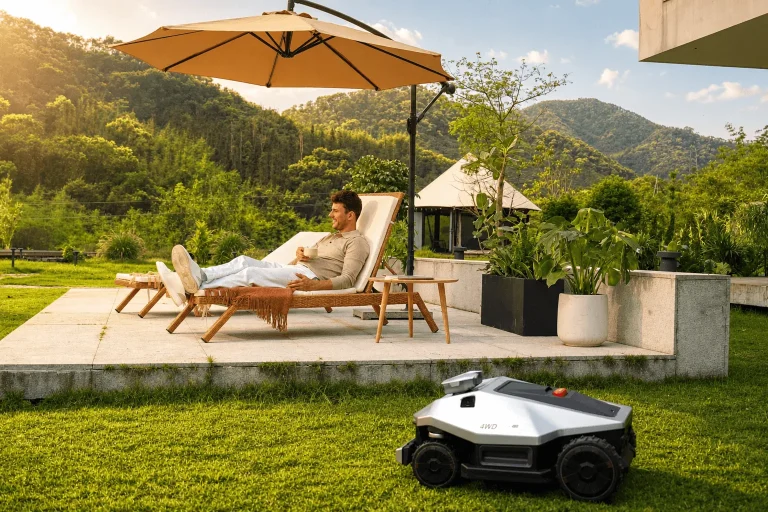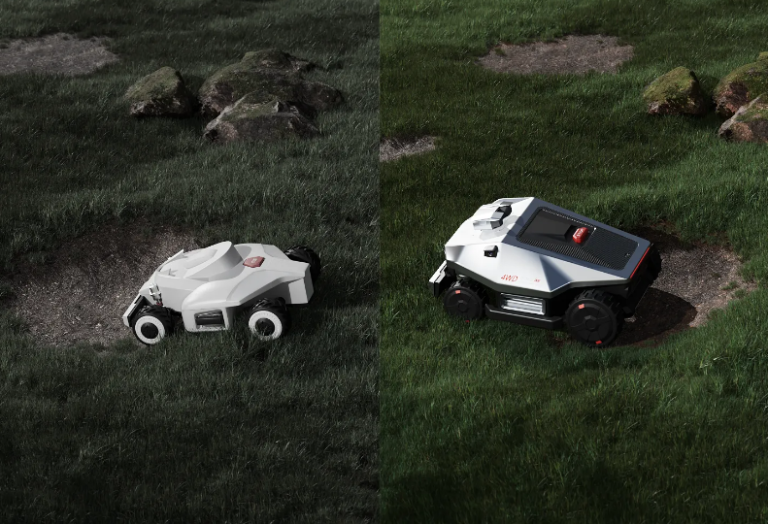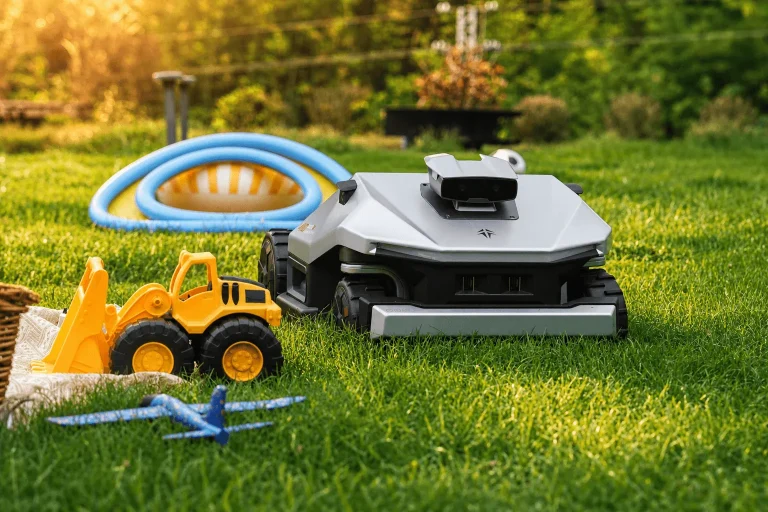
Nobody judges a lawn by its middle. The middle is easy — any machine with a spinning blade will do a passable job across an open field of turf.
The lawn is judged at its edges: the crisp line where turf meets driveway, the clean arc around a flower bed, the strip along the fence. That’s where amateur results announce themselves, and it’s where the honest conversation about robotic mowing has to happen.
Because here’s the thing nobody selling a robot lawn mower likes to say out loud: every mower leaves an uncut margin at the boundary. Every single one. The question is not whether the margin exists. The question is how wide it is, why it’s that wide, and what technology narrows it.
The Geometry Problem Nobody Escapes
Start with a physical constraint no software can argue with.
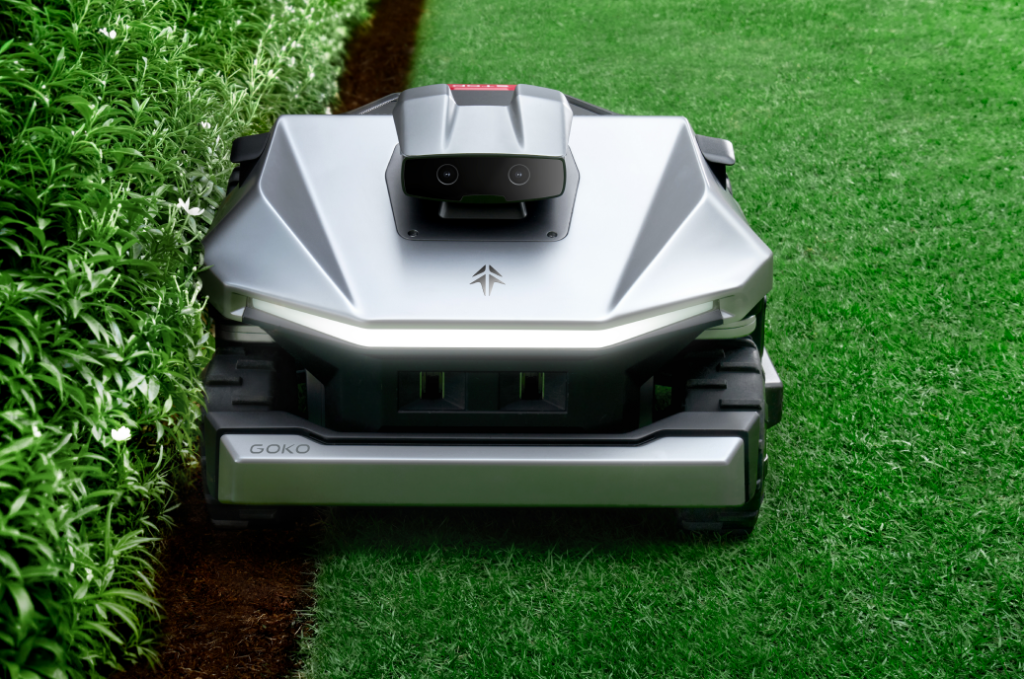
A mower has a chassis width and a cutting width, and the second is always smaller than the first. The GOKO M6 robot lawn mower measures 22.4 inches across the body and cuts a 16.5-inch swath. The wheels must stay on the turf. The blade lives inboard of the wheels. Therefore, when the outer wheel reaches the edge of the lawn, the blade has already stopped roughly three inches short.
That residual band is the offset, and it is structural. A gas push mower has it too — which is precisely why you own a string trimmer. The entire trimmer industry exists to service an inch or two of geometry.
So a lawn robot for precise edge cutting isn’t trying to eliminate the offset. It’s trying to make the offset small, consistent, and repeatable. Small so it’s invisible. Consistent so it doesn’t wander into a scalloped, wavy border. Repeatable so it lands in the same place every week rather than randomly nibbling.
Where Traditional Approaches Lose
The gas push mower
Best-case offset, worst-case labor. An attentive operator can walk the deck right up to the hardscape and produce a genuinely tight line — then spends fifteen minutes with a trimmer finishing what the deck couldn’t reach, and another ten with a blower cleaning the driveway. The edge is excellent. The cost is your Saturday, every Saturday, and the consistency depends entirely on how tired you are by the back fence.
The wire-guided robot mower
This is where the offset quietly balloons, and it’s the single least-understood fact in robotic mowing.
Boundary wire doesn’t mark the edge of the lawn. It marks the edge of the permitted travel zone, and every manufacturer specifies a setback — the wire must be buried some distance inside the true border, so the machine has room to detect the signal, decelerate, and turn without dropping a wheel onto the driveway or into the pond.
Add the setback to the deck offset and you get a compounded uncut strip that can approach a foot on the pond side. Worse, the turn itself is usually a bump-and-pivot: sense the wire, stop, rotate through a semi-random angle, drive on. The border isn’t a line the mower follows. It’s a wall it bounces off. The resulting edge is not crisp — it’s fuzzy, because the machine never traveled parallel to it in the first place.
The compounding problem
| Boundary defined by | Positioning accuracy | Path relative to edge | Trimmer still needed | |
| Gas push mower | Operator’s eyes | Human | Parallel, manual | Yes, every mow |
| Wire-guided robot | Buried cable + setback | Signal proximity only | Perpendicular bounce | Yes, frequently |
| RTK virtual-boundary robot | Map coordinates | Centimeter-class | Parallel, planned | Occasionally |
The Four Variables That Actually Determine Edge Quality
1. Can the machine know where the edge is? Wire tells a robot only “you are near a signal.” RTK tells it “you are at this coordinate, and the boundary runs through that coordinate.” One is proximity. The other is position. Only the second permits following a line.
2. How is the boundary defined? A buried wire is a physical object with an installation tolerance and a mandatory safety setback. A virtual boundary is a set of coordinates, drawable to the actual grass line, with no cable to protect from a wheel.
3. Deck and overhang geometry. Fixed physics, discussed above.
4. Steering geometry at the turn. This is the underrated one. A skid-steering robot pivots by dragging its wheels in opposite directions. Do that at the lawn’s edge, weekly, in the same spot, and you get scuffed, torn, compacted turf right where the eye is drawn.
How the GOKO M6 Approaches the Border
Position, not proximity. CyberNav™ Fusion Navigation blends RTK and nRTK satellite correction with VSLAM visual navigation, an IMU, and wheel odometry. The mower knows where it is to centimeter-class precision, so it can drive along a boundary rather than ricochet off one. GOKO describes the M6 robot lawn mower as designed to mow as close as possible to its virtual boundaries.
Boundaries in software. Auto Mapping generates the virtual map with no wires, stakes, or manual tracing — which means no setback allowance, and no cable a wheel might sever. No-go zones around beds, ponds, and tree rings are drawn in the app and edited in seconds. Adjusting the border after you extend a patio is a drag of a finger, not a spade.
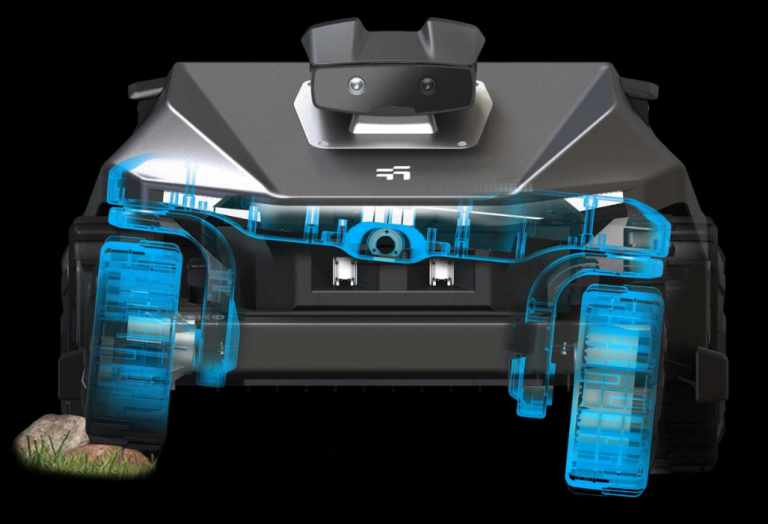
Turns that don’t tear turf. Front-wheel active steering is the quiet hero of edge work. Independent steering delivers tighter, cleaner turns with less wheel drag — reducing turf damage and improving coverage precisely at the boundary, where the machine turns most and the damage shows most.
Different tracks every session. Intelligent path planning varies the mowing pattern each task, so wheel tracks don’t compound into a permanent rut along the border. Over a season, this is the difference between a precision lawn mower and a machine that etches its own habits into your grass.
A clean cut, not a torn one. 16.5-inch swath, 250 W × 2 blade power, and two swappable systems: Razor Disc Blades at 3,000 RPM for a quiet, efficient finish, or Rotary Mulching Blades at 5,000 RPM for strong even cutting on heavy growth. GOKO rates the dual-blade system for clean cuts and crisp edges across grass conditions.
Honest caveat, from GOKO itself. Actual cutting distance and edge finish vary with the type of edge — bare soil, exposed grass roots, a flush concrete border, or a raised concrete or ceramic block all behave differently. Any vendor promising a single fixed number for every edge in every yard is selling you a spec, not a result.

Engineering Your Lawn for a Better Edge
The mower is half the system. The border is the other half.
- Install a mowing strip. A flush row of pavers or a concrete band level with the turf lets the wheel ride on the hardscape and the blade reach the last inch of grass. This is the single highest-leverage change you can make.
- Avoid raised edges. A curb that stands proud of the lawn forces the mower to keep its wheels back, mechanically widening the offset.
- Keep the boundary’s sky clear. RTK correction depends on satellite visibility. A boundary hugging a two-story wall is the hardest place to hold centimeter accuracy — which is where VSLAM and the IMU carry the load.
- Draw the map tight. The virtual boundary can sit at the grass line. Put it there.
- Keep the trimmer. Three or four times a season, not fifty-two.
FAQs
Q: How close to the edge does the GOKO M6 actually cut?
GOKO’s own position is that the M6 robot lawn mower is designed to mow as close as possible to its virtual boundaries using CyberNav, and that actual cutting distance and edge finish vary depending on the border type — soil, exposed roots, a flush concrete edge, or a raised concrete or ceramic block each produce a different result. Flush borders yield the tightest finish.
Q: Why does a wire-guided robot mower leave such a wide uncut strip?
Two reasons stack. The buried wire must be set back inside the true lawn edge so the mower can stop and turn safely, and the blade sits inboard of the wheels. Setback plus deck offset compounds into a visibly wide margin. A virtual boundary removes the first of those two terms entirely.
Q: Will I still need a string trimmer?
For a truly flush finish against walls, fence posts, and raised borders — yes, occasionally. No wheeled mower of any kind reaches a vertical surface, because the wheel gets there before the blade does. The realistic promise of a lawn robot for precise edge cutting is a few trimmer sessions per season instead of one per mow.
Q: Does mowing the same edge every week damage the turf?
It can, on machines that pivot in place at the boundary. The M6 mitigates this two ways: front-wheel active steering turns with less wheel drag, and intelligent path planning changes the pattern each session so tracks don’t accumulate in one line.
The Finally
Edge quality is not a feature you buy. It’s an outcome of four things: how precisely the machine knows its position, how honestly the boundary is defined, how the deck sits relative to the wheels, and how gently the machine turns.
Buried wire loses on the first two. Skid steering loses on the fourth. A robot lawn mower navigating by centimeter-class fusion positioning, turning on independent front wheels, along a boundary drawn on the actual grass line, wins on all four — and leaves you a border that looks like someone cared.