Search “gas mower pollution” and you’ll be told that one hour of mowing equals driving a car 45 miles. Or 100 miles. Or 300 miles. Or that a single mower pollutes as much as 43 cars driven for a year.
These cannot all be true. They also aren’t lies. The spread is the most interesting thing about this topic, and understanding why it exists is the difference between repeating a slogan and actually knowing what your lawn costs the air.
So let’s do this properly — with sources, with caveats, and with an honest accounting of where an electric lawn mower genuinely wins and where the marketing overstates.
Why the Numbers Disagree
Three variables move the answer by an order of magnitude.
Which pollutant? Carbon dioxide, carbon monoxide, hydrocarbons, nitrogen oxides, and fine particulates behave completely differently. A gas mower is a modest CO₂ emitter and a catastrophic smog-precursor emitter, because small engines lack the catalytic converters and closed-loop fuel management that cars have carried since the 1970s. Quote a CO₂ comparison and you get a small number. Quote a smog-forming comparison and you get a huge one.
Which mower? A residential push mower and a commercial walk-behind are different machines by a factor of several.
Which car? “A car” in 1993 and “a new light-duty passenger car” in 2026 differ enormously, because cars got dramatically cleaner while small engines barely moved.
Here’s the same question, answered honestly at both ends:
| Comparison | Figure | Source |
| New gas mower, 1 hr — VOC + NOx | ≈ driving 45 miles | EPA, cited by NH DES |
| Commercial gas mower, 1 hr — smog-forming | ≈ driving 300 miles | California Air Resources Board |
| Commercial backpack leaf blower, 1 hr — smog-forming | ≈ driving 1,100 miles | CARB |
Both the 45 and the 300 are defensible. They answer different questions. Anyone quoting one without saying which is selling you something — and that includes people selling eco friendly lawn mower hardware.
What Actually Comes Out of a Small Engine
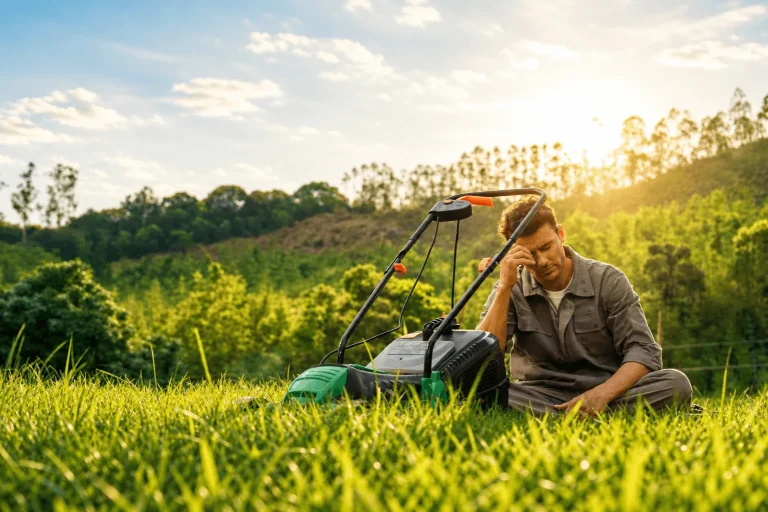
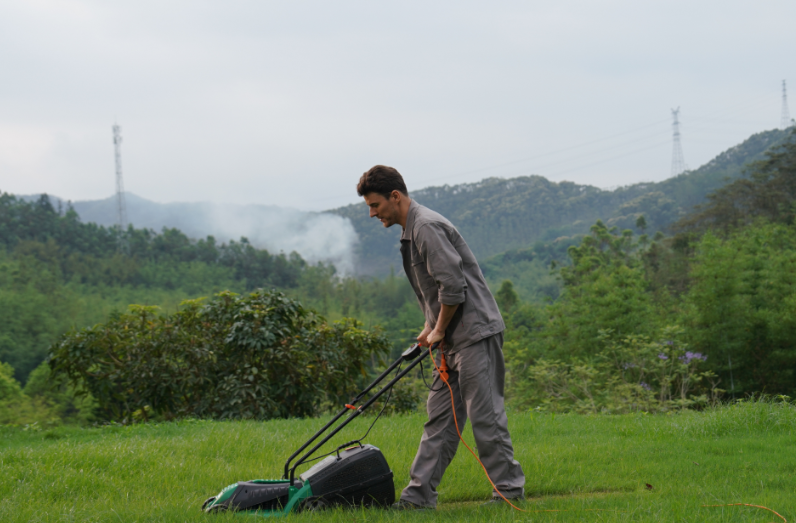
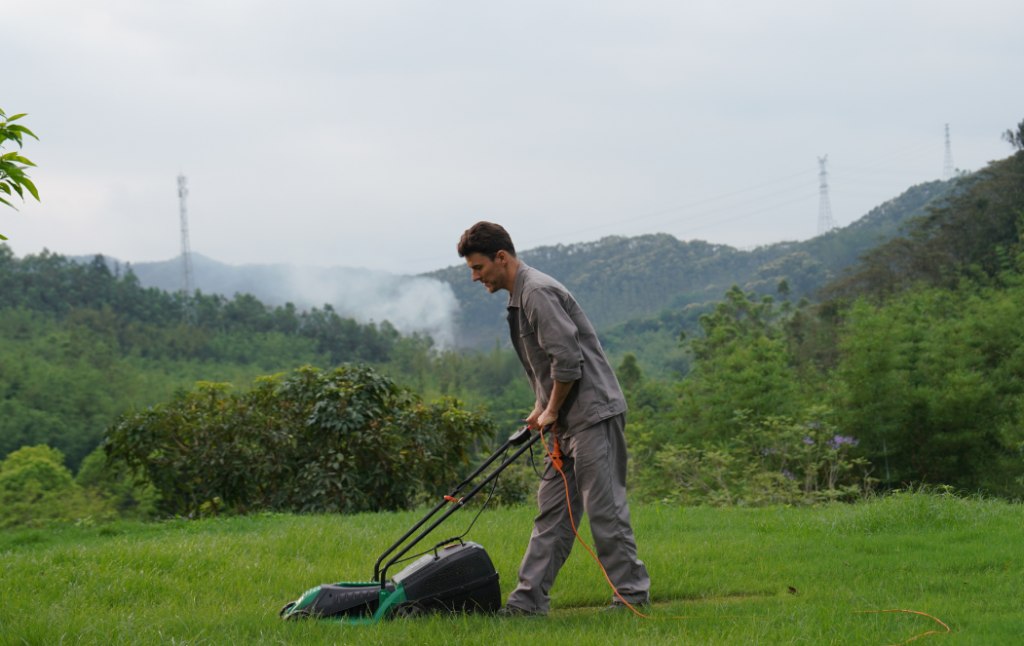
Set the mileage analogies aside. The physical output of a gas mower includes hydrocarbons, nitrogen oxides, carbon monoxide, fine particulate matter, and volatile organic compounds — several of which are respiratory irritants, and some of which are known carcinogens. The operator stands directly downstream of the exhaust for the duration.
The scale is not trivial. CARB reports that smog-forming emissions from small off-road engines have already surpassed those from all of California’s light-duty passenger cars, and are projected to be nearly twice as high by 2031. Nationally, non-road engines account for a meaningful share of certain pollutant categories.
And combustion isn’t the only pathway. The EPA estimates that on the order of 17 million gallons of gasoline are spilled every year in the United States simply while refueling lawn equipment — that’s fuel that never burns, evaporating into air or soaking into soil. Add evaporative emissions from the tank and the gas can in your garage, neither of which appears in any “hour of mowing” statistic.
Then there’s noise, which is a pollutant with its own epidemiology. Heavy-duty gas equipment routinely exceeds 85 dB(A), the threshold at which sustained exposure damages hearing.
The Regulatory Tide Has Already Turned
This matters for anyone buying equipment that should last a decade.
California — which adopted the world’s first small-engine emissions standards back in 1990 — passed AB 1346, and CARB amended its rules so that most newly manufactured small off-road engines sold in the state must meet zero-emission standards from model year 2024 onward. A second phase extends this to generators and large pressure washers in 2028. Existing equipment remains legal to use; the restriction applies to new manufacture and sale.
A 2020 executive order set a broader goal of 100% zero-emission off-road equipment in California by 2035 where feasible. Other municipalities and states have enacted or considered similar restrictions; a few have moved the other direction and preempted local bans.
The direction of travel is unambiguous. Buying a gas mower in 2026 is buying into a category that regulators, and increasingly retailers, are exiting.
What “Zero Emission” Honestly Means
Here’s where most green-marketing copy quietly cheats, and where a robot mower for eco friendly lawn care deserves a more careful claim.
A battery-electric mower has zero emissions at the point of use. No exhaust, no unburned fuel, no evaporative loss, no spillage, no benzene in the operator’s breathing zone, no soil contamination. That claim is exact and it is not small.
It does not mean zero lifecycle emissions. Three honest asterisks:
- The electricity comes from somewhere. Charging draws from your grid mix. The upside: a machine charged from a grid that decarbonizes gets cleaner every year it’s owned. A combustion engine never does. Charge from rooftop solar and the operational footprint approaches zero in a way no gas engine can approach at any price.
- Lithium-ion batteries carry a manufacturing footprint and an end-of-life obligation. They should be recycled, not landfilled.
- The lawn itself is the bigger question. Turfgrass is a shallow-rooted monoculture and a comparatively poor carbon sink. The most environmentally significant lawn decision most people can make isn’t which mower to buy — it’s how much lawn to keep.
Any brand that tells you a mower makes your yard carbon-negative is not being straight with you.
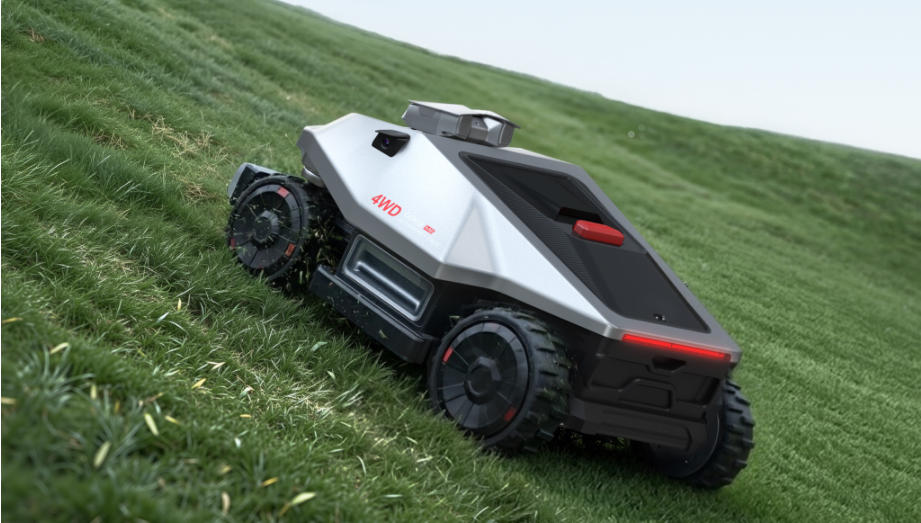
GOKO’s Model: Green Lawn Care Beyond the Tailpipe
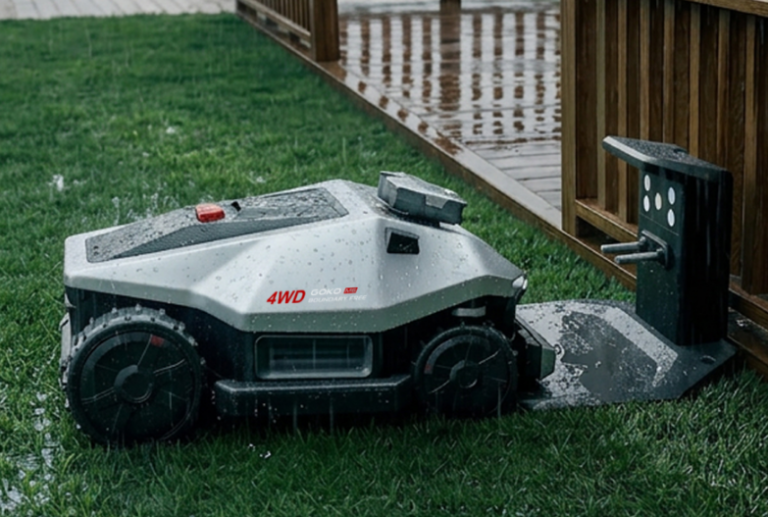
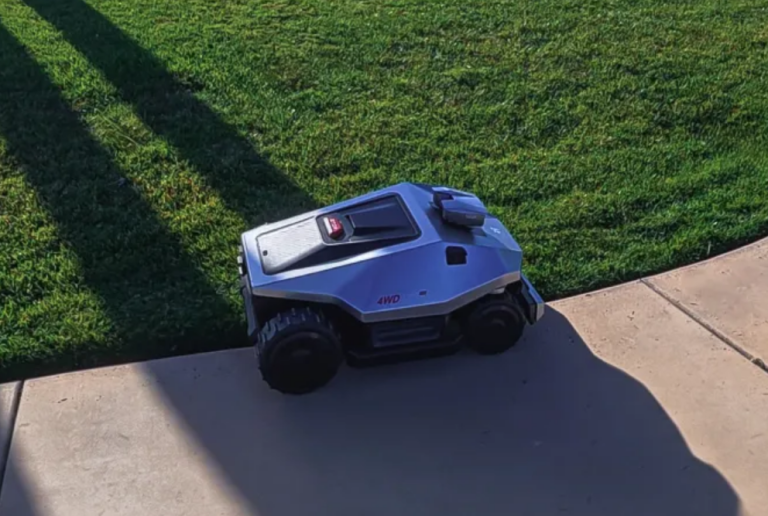
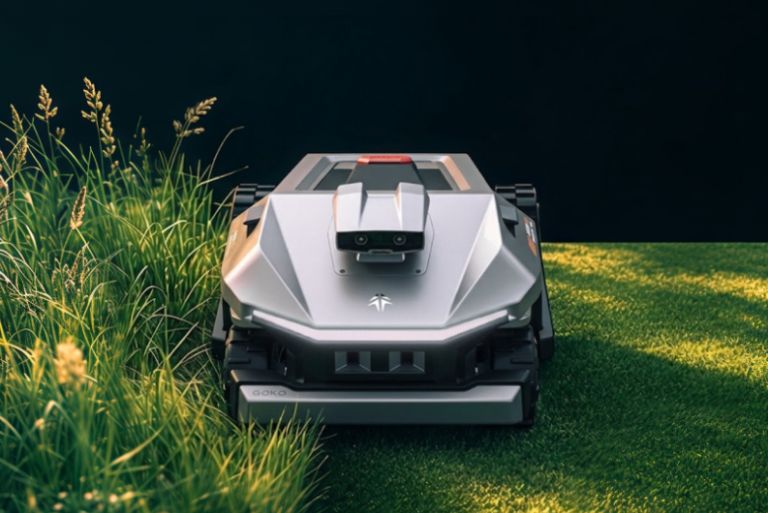
With that honest framing, here’s what a well-designed robotic mower contributes beyond eliminating combustion. The GOKO M6 is a useful case study.
No fuel, no oil, no spills. No gas can, no winterizing, no oil change, no stabilizer, no 17-million-gallon problem. The maintenance chain that produces most of the non-exhaust pollution simply doesn’t exist.
A closed nutrient loop. The M6’s Rotary Mulching Blades cut clippings fine enough to fall back into the canopy and decompose, returning nitrogen and organic matter to the soil. A mulched lawn is a lawn that needs less synthetic fertilizer — which in turn means less nitrogen runoff into waterways, arguably the single largest environmental externality of American lawn care.
Little and often, not rare and brutal. Robotic mowers cut frequently and shallowly, honoring the agronomic one-third rule. Healthier turf, deeper roots, better water infiltration, less irrigation demand.
Soil that stays uncompacted. Intelligent path planning varies the mowing pattern each session, so wheel tracks don’t harden into ruts. Compacted soil chokes root respiration and sheds rainwater instead of absorbing it.
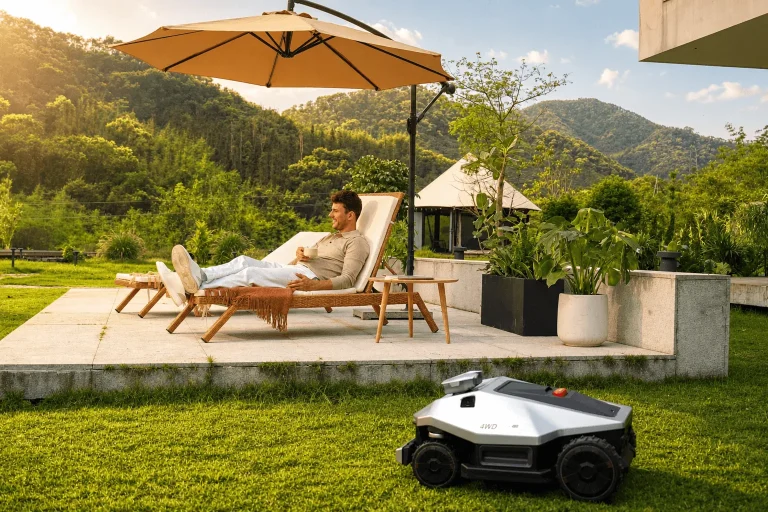
Noise as pollution. Under 62 dB(A) in Razor Blade Mode — around the level of conversation, versus the 85+ dB(A) of gas equipment. The 4WD electric drivetrain has no combustion event to silence in the first place.
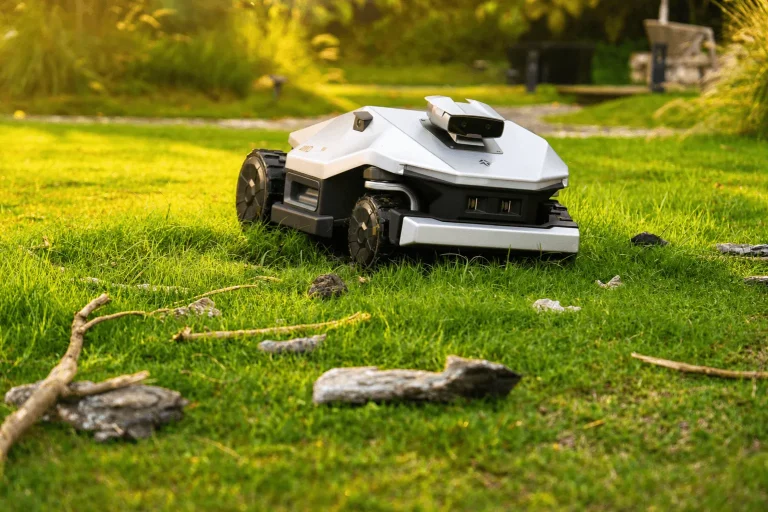
Wildlife awareness. The QuadVision system’s four AI cameras recognize 200+ object categories, including hedgehogs, cats, and rabbits. Small-mammal injury is a real and documented cost of robotic mowing; object recognition is how it gets addressed.
No crew, no truck. A machine that mows itself removes weekly trailer trips from a landscaping vehicle — an emissions line item that never appears in any mower comparison, and often exceeds the mower’s own.
FAQs
Q: Is a robot mower really better for the environment than a gas mower?
At the point of use, unambiguously. It produces no exhaust, no evaporative emissions, and no fuel spillage, and it operates around 62 dB(A) rather than 85+. Lifecycle-wise it depends on your grid and on responsible battery recycling — but a gas engine’s emissions are fixed forever, while an electric machine’s fall as the grid cleans up.
Q: How much pollution does a gas mower actually create?
Depending on which pollutant and which machine, one hour of gas mowing has been equated by the EPA to roughly 45 miles of driving for VOCs and NOx, and by CARB to about 300 miles for smog-forming emissions from a commercial mower.
Q: Will I be forced to replace my gas mower?
Not retroactively. California’s rules restrict the manufacture and sale of new small off-road engines from model year 2024; existing equipment stays legal to operate. But new purchases in that state, and increasingly elsewhere, are moving to zero-emission by default.
Q: Does mulching really reduce fertilizer use?
Clippings are roughly 3–4% nitrogen by dry weight, and returning them to the turf recycles a meaningful share of the nitrogen a lawn needs. Mulching won’t eliminate fertilization on depleted soil, but it reduces the requirement — and reducing applied nitrogen reduces runoff.
The strongest environmental argument for an eco friendly lawn mower isn’t a single dramatic statistic. It’s the accumulation: no exhaust, no spilled fuel, no evaporative loss, no 90-decibel Saturday, no synthetic nitrogen you didn’t need, no truck idling at the curb — on a machine that gets cleaner every year the grid does.
Cut less, cut often, return the clippings, keep the noise down, and let the machine do it while you’re not there. That’s not a slogan. That’s just better lawn care that happens to be greener.