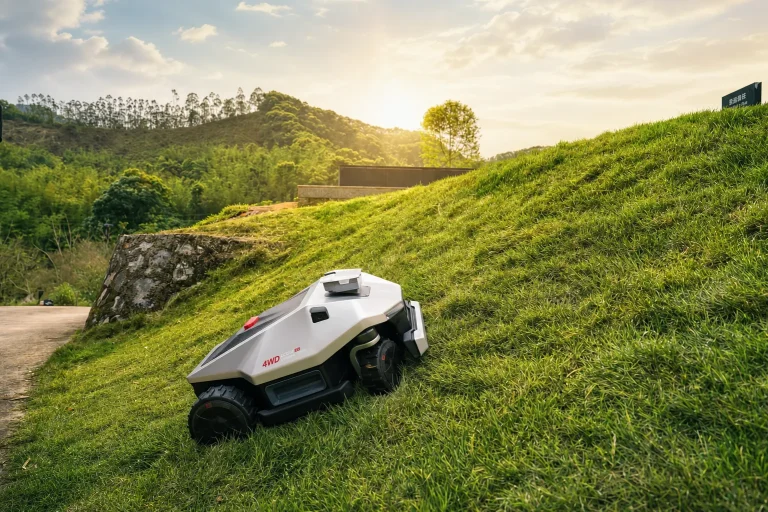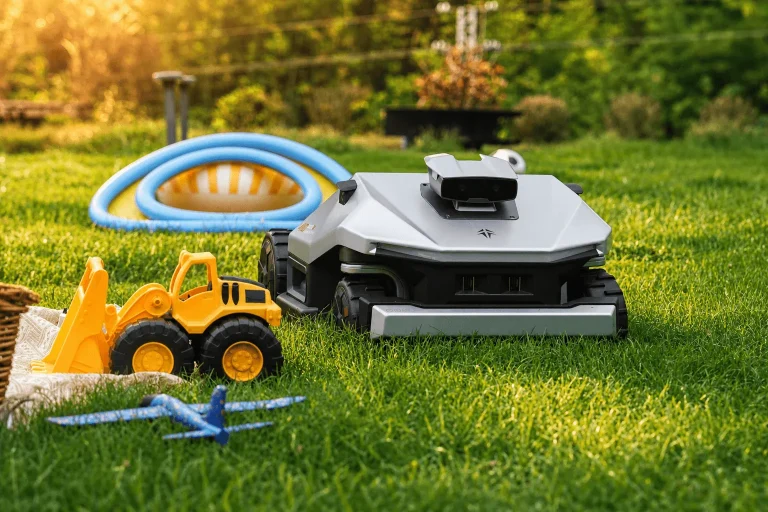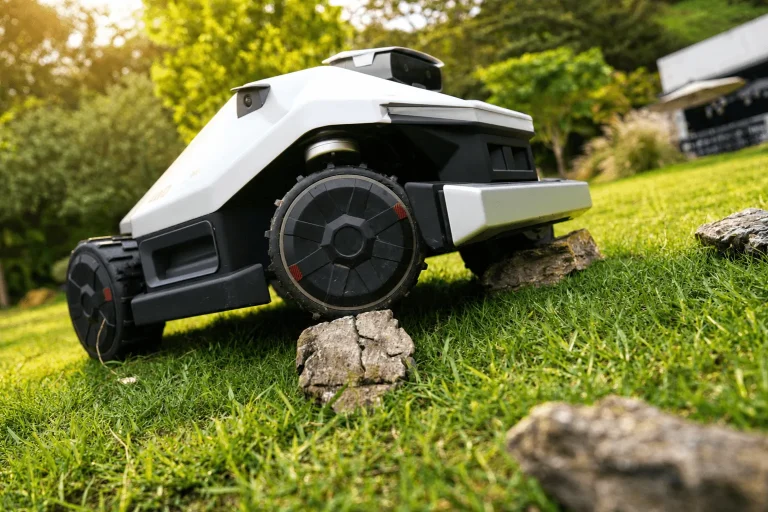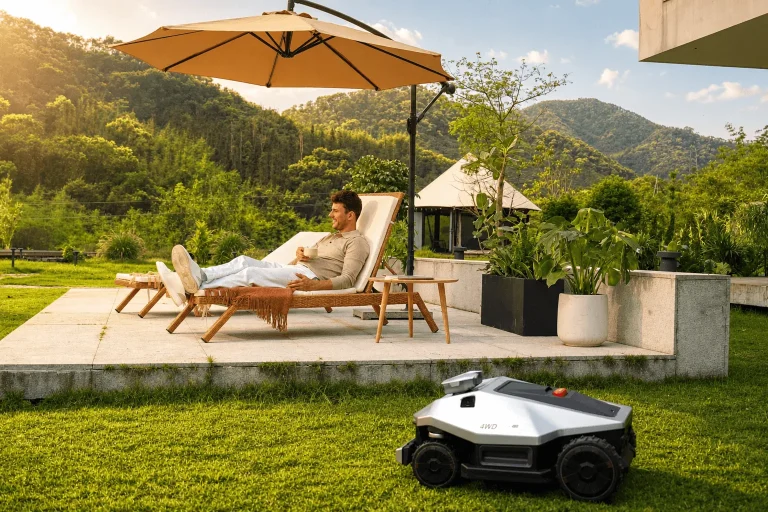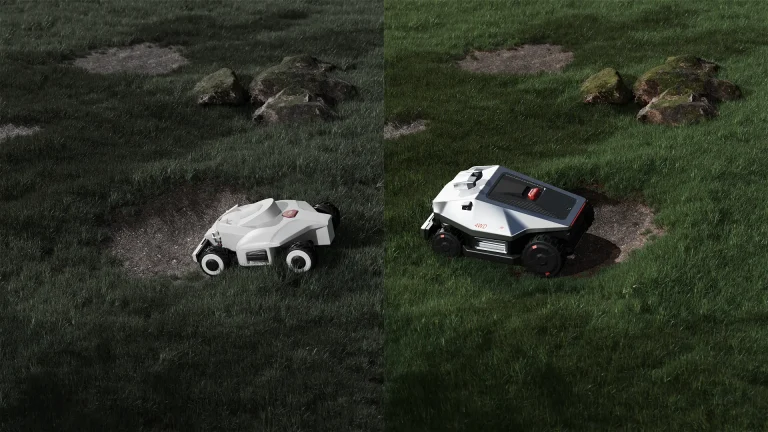
Ask most people how a robot mower avoids a garden hose, and they picture a sensor that “sees” the hose and stops. But detecting that something is there and understanding what it is are two very different engineering problems — and the gap between them is exactly where most robot mowers quietly fail. A spinning blade doesn’t get second chances around a sleeping cat or a child’s bare foot, so the question that really matters isn’t “can it sense an obstacle?” It’s “does it know what it’s looking at?” That single distinction is the clearest lens for understanding the GoKo M6 and its AI QuadVision system — and for telling a genuinely smart obstacle avoiding mower apart from one that’s merely bumping its way around the yard.
Seeing an obstacle vs. understanding it
Every obstacle-avoidance system is trying to answer two questions: Is there something in my path? and What should I do about it? The first is detection. The second requires recognition — actually identifying the object so the machine can respond appropriately. A rock, a flowerbed, a garden gnome, and a napping dog might all register as “obstacle ahead,” but a truly intelligent AI lawn mower treats them very differently: edge around the flowerbed, give the dog a wide and cautious berth, and ignore the few tall blades of grass that aren’t obstacles at all.
For most of robot-mower history, machines only managed detection — and crudely. Looking at the four main ways a mower can sense the world makes it obvious why recognition is the hard-won upgrade.

The four ways a mower senses the world
Contact and bump sensors. The oldest approach. The mower physically drives into an object, a bumper or switch registers the collision, and the machine reverses and turns. It’s cheap and dependable for walls and fences, but it only “knows” about an obstacle after hitting it — a non-starter for pets, bare feet, delicate plants, or anything fragile.
Ultrasonic sensors. These emit high-frequency sound pulses and listen for the echo, estimating distance from the round-trip time — the same trick bats use. Ultrasonic gives a basic, no-contact “something’s ahead” warning, but it has real limits. It can’t tell you what the object is, it covers only a narrow cone, and it’s easily fooled: tall grass can bounce the signal back and trick the mower into stopping in the middle of an uncut patch, while thin or sound-absorbing things (cables, table legs, soft toys) can slip past undetected.
LiDAR. Light Detection and Ranging fires rapid laser pulses and times their return to build a precise 3D “point cloud” of the surroundings. It’s the headline sensor on premium machines like the Ecovacs GOAT, and it’s genuinely excellent: millimeter-class distance accuracy, reliable obstacle geometry, and — because it makes its own light — it works in the dark. Its trade-offs are cost (laser hardware is expensive) and conditions (fog, heavy rain, and dust scatter the beams). Crucially, raw LiDAR reads shape, not meaning: it knows a 30-centimetre object sits two metres ahead, but not whether that’s a rock or a rabbit — which is why the best LiDAR mowers bolt a camera on top anyway.
AI camera vision. Cameras capture the scene the way our eyes do, and a trained neural network classifies what’s in the frame — person, pet, hose, planter, toy. This is the only approach that delivers true recognition rather than mere detection. Its honest limitation is light: cameras need adequate illumination to see well, so glare, dusk, and darkness all reduce performance. The other classic weakness of single-camera systems is a narrow field of view with blind spots along the sides and rear.
Inside AI QuadVision: how the GoKo M6 sees
This is the design problem the GoKo M6 sets out to solve, and the answer is in the name: QuadVision uses four AI-powered cameras instead of one. That choice attacks the two biggest weaknesses of vision systems head-on.
First, coverage. Four cameras spread around the machine deliver a far wider, more overlapping field of view than a single front lens, shrinking the side and rear blind spots where a one-camera obstacle avoiding mower would miss a child stepping in from the edge or a toy left on the flank.
Second, recognition. The GoKo M6’s onboard AI is trained to identify over 200 types of objects — people, pets, toys, furniture, garden tools — and to respond in real time. It isn’t just stopping for “an obstacle”; it’s recognizing a category and choosing a safe, appropriate maneuver. That’s the practical difference between a mower that taps a stray football and one that flows smoothly around both a football and a sleeping puppy without touching either.
Just as important is what sits underneath the cameras. Obstacle avoidance and navigation are separate jobs, and the GoKo M6 keeps them separate. Its CyberNav fusion system handles positioning by combining RTK satellite accuracy, VSLAM visual mapping, an IMU (inertial motion sensor), and wheel-tracking odometry. So even when one input weakens, the mower still knows where it is — which is what makes it a genuinely self navigating lawn mower rather than one that wanders the moment a single sensor struggles. QuadVision then rides on top of that stable platform, watching for the unpredictable things that move into a yard after the map is made: the dog, the hose, the wheelbarrow left out overnight.
How AI QuadVision compares to the alternatives
| Bump sensors | Ultrasonic | LiDAR | GoKo M6 AI QuadVision | |
| How it works | Physical contact | Sound-wave echo | Laser 3D mapping | 4 AI cameras + neural net |
| Detects obstacles? | Only after contact | Yes, basic | Yes, precise geometry | Yes, wide coverage |
| Recognizes what it is? | No | No | Not on its own | Yes — 200+ object types |
| Field of view | Front only | Narrow cone | Wide / 360° | Wide, multi-camera |
| Works in the dark? | n/a | Yes | Yes | Needs adequate light |
| Main weak spot | Touches objects first | Fooled by grass & thin items | Cost, fog/rain | Low light |
| Relative cost | Low | Low | High | Moderate |
Read across the table and a pattern appears: no single sensor is perfect, and each one’s strength is another’s blind spot. LiDAR wins on darkness and geometry; ultrasonic and bump sensors win on price; camera vision wins, decisively, on understanding the scene. For a domestic lawn — full of the exact moving, fragile, unpredictable things that recognition is built for — knowing the difference between a hedge and a hedgehog is the feature that actually keeps the yard safe.
Why recognition is the feature that matters
The reason the detection-versus-recognition distinction deserves all this attention is simple: your lawn is not an empty field. It has kids, pets, toys, tools, and furniture that appear and move without warning. A bump-sensor mower learns about them by hitting them. An ultrasonic mower might stop — or might not register the garden cable at all. An AI lawn mower that can genuinely recognize 200+ objects can make a smarter call: slow down, steer around, hold its distance. That is exactly the behaviour you want from a 5,000-RPM blade sharing space with your family.
That’s the case for the GoKo M6’s approach. Pair recognition-grade camera vision with fusion-based positioning, and you get a self navigating lawn mower that doesn’t merely avoid the wall it’s about to hit — it understands the yard it’s working in.
FAQ
Does the GoKo M6 use LiDAR?
No. The GoKo M6 uses AI QuadVision — four AI-powered cameras — for obstacle avoidance, paired with CyberNav fusion navigation (RTK, VSLAM, IMU, and wheel tracking) for positioning. The camera-based approach is chosen for object recognition: identifying what an obstacle is, not just that one exists.
How many objects can the GoKo M6 recognize?
Its QuadVision AI is trained to identify more than 200 types of objects — including people, pets, toys, and furniture — and to react to them in real time.
Does camera-based obstacle avoidance work at night?
Cameras depend on adequate light, which is an inherent trade-off of any vision system, so daytime or daylight-hours mowing gets the best results. The mower’s CyberNav fusion navigation keeps tracking its position regardless, but for obstacle avoidance specifically, good lighting matters.
Is the GoKo M6 a self navigating lawn mower?
Yes. It’s wire-free — no buried perimeter loop to install — and uses CyberNav fusion navigation to map and move through the yard autonomously, with QuadVision handling real-time obstacle avoidance on top.
The smartest obstacle avoiding mower isn’t the one with the most exotic sensor — it’s the one that knows what it’s looking at. Bump sensors react after contact, ultrasonic flags presence without identity, and LiDAR maps shape brilliantly but reads no meaning on its own. By building obstacle avoidance around four AI cameras that recognize 200+ objects, and layering it on stable fusion navigation, the GoKo M6 is designed to do what a real backyard actually demands: not just see that something is there, but understand what it is — and mow safely around it.