Everyone knows the sound of a Saturday morning. Somewhere down the street, a two-stroke engine coughs, catches, and settles into a flat 95-decibel roar that will last ninety minutes. Nobody sleeps through it. Nobody talks over it.
The pitch for a robot lawn mower is that this sound disappears — that the lawn gets cut while you’re at work, or asleep, and the machine is quiet enough that nobody notices. But “quiet” is a marketing word until you attach a number to it, and even the number is meaningless until you understand what the number means.
So let’s do the education properly: what is a decibel, why do 30 decibels of difference matter so enormously, where does mower noise physically come from, and what has to be engineered away to make a low noise robotic mower for nighttime operation genuinely viable.
Decibels Are Not What Most People Think
The first thing to understand is that the decibel scale is logarithmic, not linear. Doubling the sound energy adds only 3 dB. And because human hearing is itself nonlinear, the rule of thumb that matters is different again:
A 10 dB increase is perceived as roughly twice as loud.
Run that backwards. A gas mower at 95 dB(A) is not “fifty percent louder” than a robot at 62 dB(A). It is a difference of 33 dB — which the human ear registers as something in the neighborhood of eight to ten times louder.
The “A” in dB(A) matters too. A-weighting filters the measurement to match the sensitivity curve of human hearing, which is far more responsive to mid and high frequencies than to deep bass. It’s the honest way to express how loud something actually seems.
For calibration:
| Sound | Approx. level |
| Whisper | 30 dB(A) |
| Quiet library / rural night | 35–40 dB(A) |
| Refrigerator hum | 40–45 dB(A) |
| Normal conversation | 60 dB(A) |
| GOKO M6 (Razor Blade Mode) | < 62 dB(A) |
| Vacuum cleaner | 70–75 dB(A) |
| Gas push mower | 90–100 dB(A) |
| Hearing damage threshold (sustained) | 85 dB(A) |
A gas mower is loud enough that prolonged exposure damages hearing. The M6 sits at roughly the level of two people talking.
Distance Does Most of the Work
Here’s the part that almost never gets explained. Sound from a compact source falls off with distance according to the inverse square law: every doubling of distance subtracts about 6 dB.
If the machine reads 62 dB(A) close up, then out across the yard the arithmetic is unforgiving in the best way:
- 2× the distance → ~56 dB(A)
- 4× → ~50 dB(A)
- 8× → ~44 dB(A)
- 16× → ~38 dB(A)
By the time a quiet robotic lawn mower for backyard use has moved a few dozen feet from a bedroom window, it is already down in the range of a refrigerator’s hum. Add a closed double-glazed window — typically 25–30 dB of attenuation — and the mower is, acoustically, below the noise floor of the room it would be disturbing.
This is why the WHO’s night noise guidance for Europe recommends keeping outdoor nighttime levels near bedrooms under about 40 dB(A). A 62 dB(A) source, once distance and building fabric are accounted for, clears that bar comfortably. A 95 dB(A) gas engine cannot, at any realistic distance in a suburban lot.
Where Mower Noise Actually Comes From
Four sources, in descending order of contribution:
1. Aerodynamic blade noise. This dominates, and it is brutally nonlinear. The acoustic power radiated by a rotating blade scales with roughly the fifth to sixth power of tip speed. Halve the tip speed and you don’t halve the noise — you cut it by something like 15–18 dB. Tip speed is a product of RPM and radius, which is why blade geometry matters as much as motor speed.
2. Motor and drivetrain. Electrical whine, gear mesh, bearing noise. Narrow-band and tonal — which the ear finds disproportionately annoying, even at low absolute level.
3. Chassis and structure-borne vibration. Motor and blade vibration transmitted into the shell, which then radiates sound like a loudspeaker cone.
4. Wheels and turf interaction. Scrubbing, gravel, drivetrain load under torque.
And, of course, the source that doesn’t exist on an electric machine at all: combustion. No intake roar, no exhaust pulse, no cylinder detonation at ~50 Hz. That single absence accounts for most of the 30-plus decibel gap.
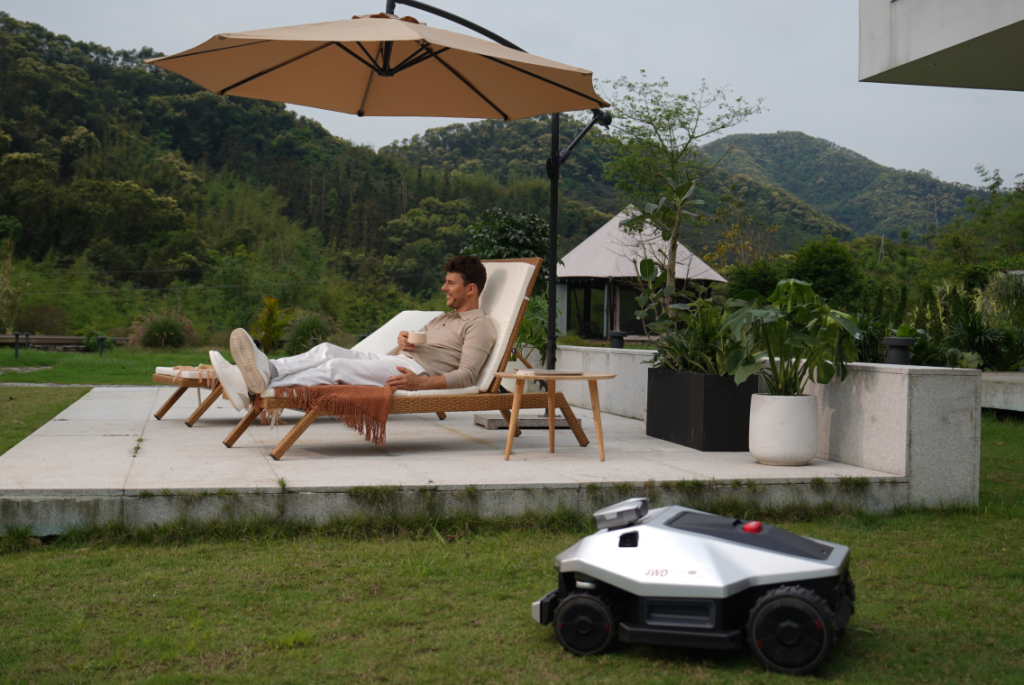
How the GOKO M6 Attacks Each Source
The blade choice is the headline. The M6 ships with two swappable cutting systems, and they are not acoustic equals by accident:
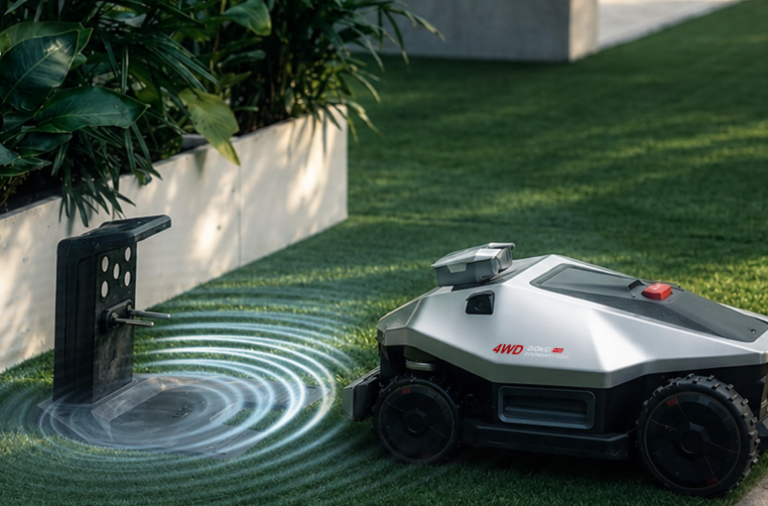
- Razor Disc Blades — 2 × 6 small pivoting razors, spinning at 3,000 RPM. Small radius, low mass, minimal air displacement. GOKO rates this configuration at under 62 dB(A), and describes it as whisper-quiet with lower power consumption.
- Rotary Mulching Blades — 5,000 RPM, built for nutrient-rich mulching and strong, even cutting on heavy growth.
That RPM gap, combined with the larger effective radius of a rotary bar, is precisely the tip-speed physics described above. The tradeoff is explicit and it’s yours to make: mulching performance, or the quietest possible night pass.
Torque instead of speed. Blade power is rated at 250 W × 2, and travel speed runs 0.9–2.2 mph. A machine that moves slowly and cuts a 16.5-inch swath doesn’t need to scream through the grass — it has time.
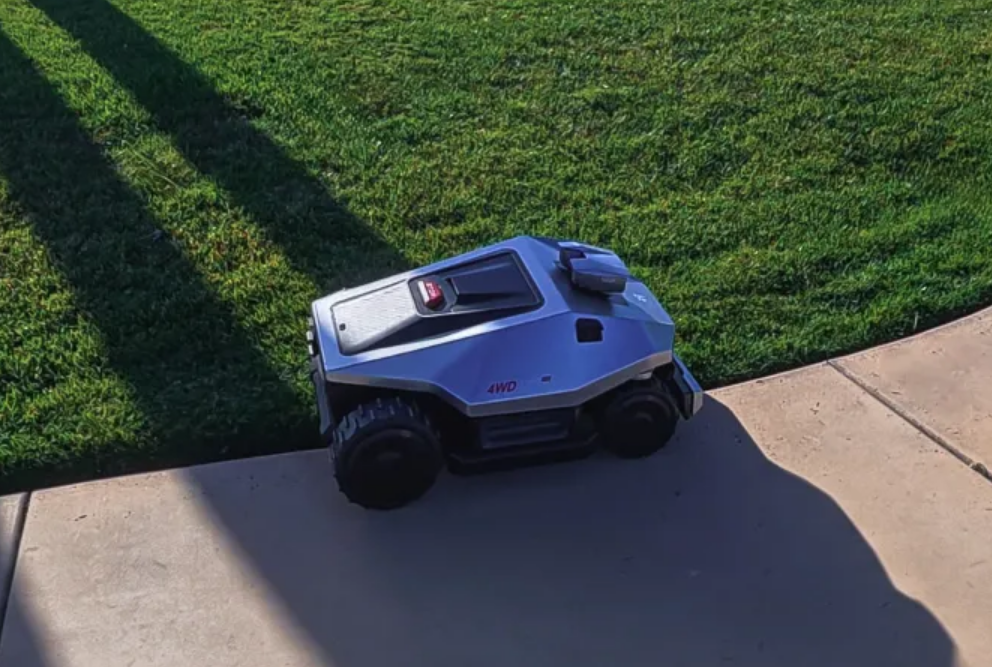
Suspension and steering. 4WD with adaptive suspension isolates chassis vibration and keeps wheels loaded evenly over roots and ruts. Front-wheel active steering produces tighter turns with less wheel drag, which means less scrubbing noise and less turf tearing.
The sealed shell. The IP66-rated enclosure that keeps dust and water out is also a mass barrier that keeps motor and blade noise in.
Why Night Is the Right Shift — If the Robot Can See
Quiet is necessary but not sufficient. A low noise robotic mower for nighttime work also has to navigate in the dark, and this is where most machines quietly fail: they depend on visual systems that need daylight.
The M6’s QuadVision system — four AI-powered cameras, including a stereo pair — is specified for reliable obstacle detection after dark, recognizing 200+ object categories including hedgehogs, cats, rabbits, and yard clutter. Nocturnal wildlife is the single strongest ethical objection to night mowing, and it is an object-recognition problem before it is anything else. Positioning holds up too: CyberNav™ fuses RTK and nRTK satellite data with VSLAM, IMU, and wheel odometry, so darkness degrades one input rather than stranding the machine.
Being a Good Neighbor Anyway
Physics is not permission. Before you schedule a 2 a.m. pass:
- Check local noise ordinances. Many municipalities restrict powered equipment between roughly 10 p.m. and 7 a.m. regardless of decibel level.
- Check your HOA. These rules are often stricter than municipal code.
- Consider dawn instead of midnight. 5–7 a.m. captures nearly all the benefit — empty yard, cool grass, no neighbors watching — with none of the ambiguity. Dew is the one caveat.
- Position the dock away from property lines. Docking and undocking are the loudest, most transient events in a mowing cycle, and transients are what wake people.
FAQs
Q: How loud is the GOKO M6, exactly? Under 62 dB(A) in Razor Blade Mode — roughly the level of ordinary conversation, and around 30 dB below a typical gas mower. Because decibels are logarithmic, that gap represents something on the order of an eight-to-tenfold reduction in perceived loudness. Rotary Mulching Blade mode spins faster (5,000 RPM versus 3,000) and is correspondingly louder.
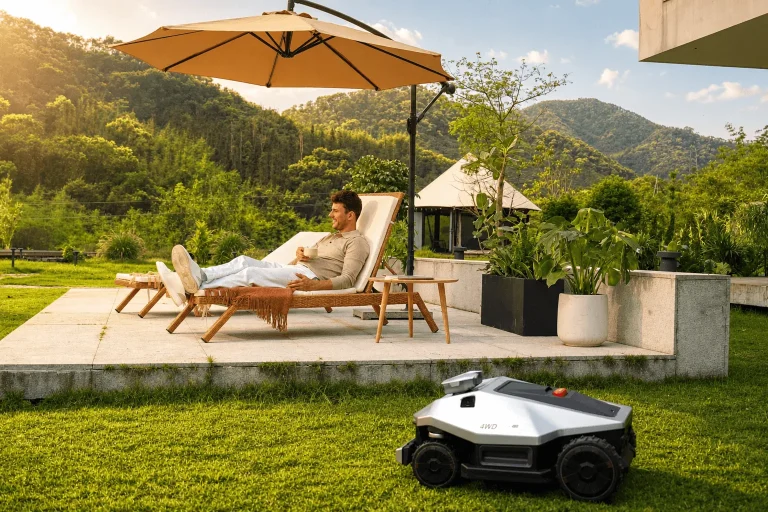
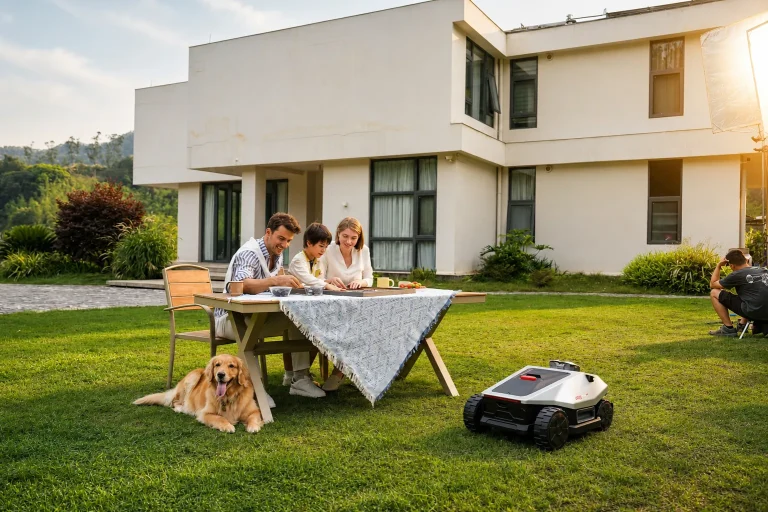
Q: Can I really run a robot lawn mower at night without upsetting neighbors? Acoustically, yes — a 62 dB(A) source loses roughly 6 dB per doubling of distance, and a closed window removes another 25–30 dB. Legally, it depends entirely on your municipality and HOA. Verify before you schedule.
Q: Why do blades have such a big effect on noise? Because aerodynamic noise scales with roughly the fifth or sixth power of blade tip speed. Small razor discs at 3,000 RPM displace far less air than a long rotary bar at 5,000 RPM. The difference isn’t incremental — it’s exponential.
Q: Does mowing at night endanger wildlife? It’s the right question to ask. The M6’s four-camera QuadVision system is specified to work after dark and recognizes hedgehogs, cats, rabbits, and other small animals among 200+ object types. That said, if your property borders woodland or you know hedgehogs den nearby, an early-morning schedule remains the most cautious choice.
Final Words
“Quiet” isn’t a feeling. It’s tip speed, motor isolation, chassis mass, and the absence of combustion — measured in a unit most people misread by an order of magnitude.
A quiet robotic lawn mower for backyard use earns the adjective by attacking noise at its physical source, not by promising it. Under 62 dB(A), moving slowly, seeing in the dark: the lawn gets cut, and the street stays asleep.