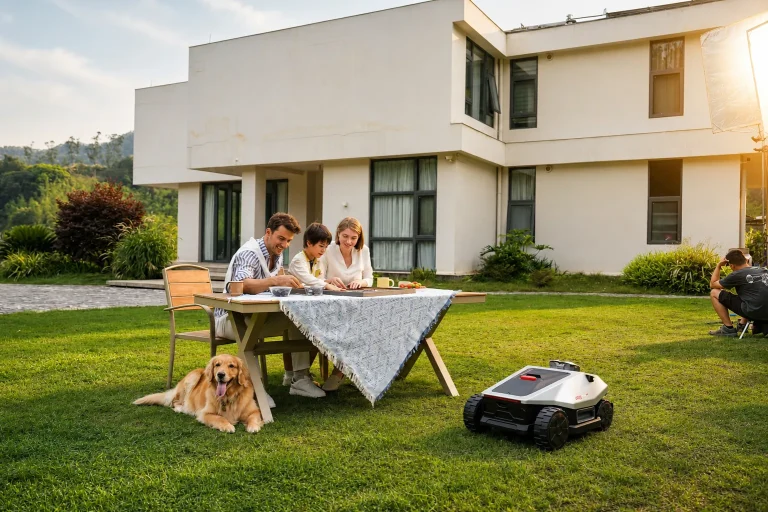
Tired of spending every weekend behind a push mower while your neighbors relax on their patios? The robotic mower revolution is no longer reserved for tech enthusiasts — it’s gone mainstream, and the options have never been better. Whether you’re browsing your first autonomous lawn mower or upgrading from an older wire-dependent model, this comprehensive pillar guide will walk you through every decision factor: lawn size, terrain complexity, navigation technology, battery life, budget, and brand credibility. And if you’re looking for a standout challenger that’s been turning heads since CES 2026, GoKo Lawn Mower — specifically the GOKO M6 — deserves a serious look.
Why Go Robotic? The Case for an Autonomous Lawn Mower
The global robotic lawn mower market is growing rapidly, and for good reason. A quality electric lawn mower robot eliminates manual labor, mows more frequently (daily or every other day) to maintain a consistently manicured look, and produces zero direct emissions compared to gas-powered alternatives. Studies from the European robotic mower market suggest owners reclaim an average of 50–100 hours per year previously spent on lawn maintenance.
Beyond convenience, modern robotic mowers are surprisingly capable. The best robotic lawn mower models of 2025–2026 feature AI-powered obstacle avoidance, wire-free GPS/RTK navigation, app control, and slope-climbing ability that would have seemed like science fiction a decade ago.And now, the GOKO M6 is here.
Why were there difficulties prior to this? Let us analyze the various factors one by one.
Factor 1: Lawn Size & Coverage Capacity
This is the single most important specification. Buying a mower rated for 0.25 acres when you have a full acre will result in a machine that’s constantly running, degrading battery performance, and never quite keeping up.
General Sizing Guidelines
| Lawn Size | Coverage Tier | What to Look For |
| Up to 0.25 acres (~1,000 m²) | Small | Budget-friendly models, 60–90 min runtime |
| 0.25–0.5 acres (~1,000–2,000 m²) | Medium | Mid-range models, 90–120 min runtime |
| 0.5–1 acre (~2,000–4,000 m²) | Large | High-performance models, expandable battery |
| 1–2.5 acres (~4,000–10,000 m²) | Estate/Commercial | Pro-grade, 4WD, multi-zone map storage |
Pro tip: Always buy one tier above your actual lawn size. Mowing efficiency is never 100% — the robot retraces paths, navigates around obstacles, and may need multiple sessions during peak growing season.
The GOKO M6 GoKo Lawn Mower is rated for lawns from 0.25 to 2.5 acres (1,000–10,000 m²), with a single-battery coverage of 0.5 acres (2,000 m²) per charge and up to 1 acre (4,000 m²) per charge with the optional extended battery. Daily coverage maxes out at 1.5–2 acres, making it one of the highest-capacity consumer models currently available.
Factor 2: Terrain & Slope Handling
Not all lawns are flat, and most robotic mowers struggle when the ground fights back. Before buying, honestly assess your terrain:
- Flat, uniform grass: Nearly any model will work.
- Gentle slopes (up to 20°/36%): Most mid-range models can handle this.
- Steep slopes (20°–45°): You need a purpose-built machine with serious traction.
- Bumpy, rocky, or uneven ground: Look for adaptive suspension and high obstacle clearance.
Why Slope Rating Matters
A mower slipping on a wet incline isn’t just inefficient — it’s a safety hazard. Most budget autonomous lawn mowers are rated for slopes up to 25–35%. If your yard includes a grade steeper than that, you’ll need a high-performance model specifically engineered for slope stability.
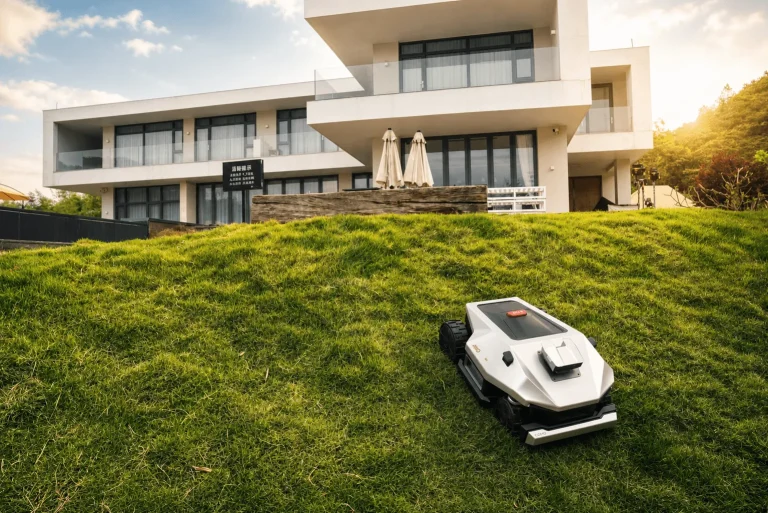
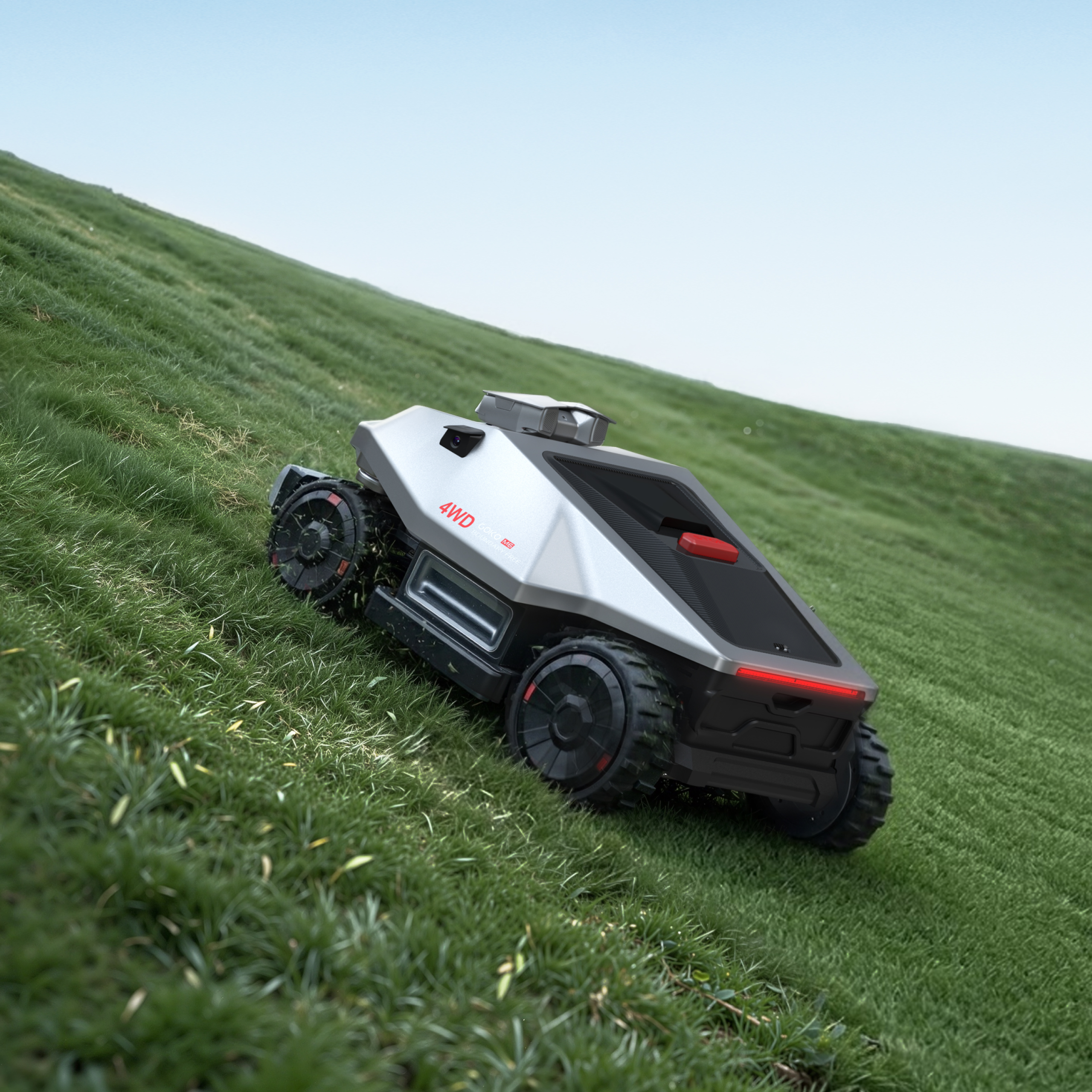
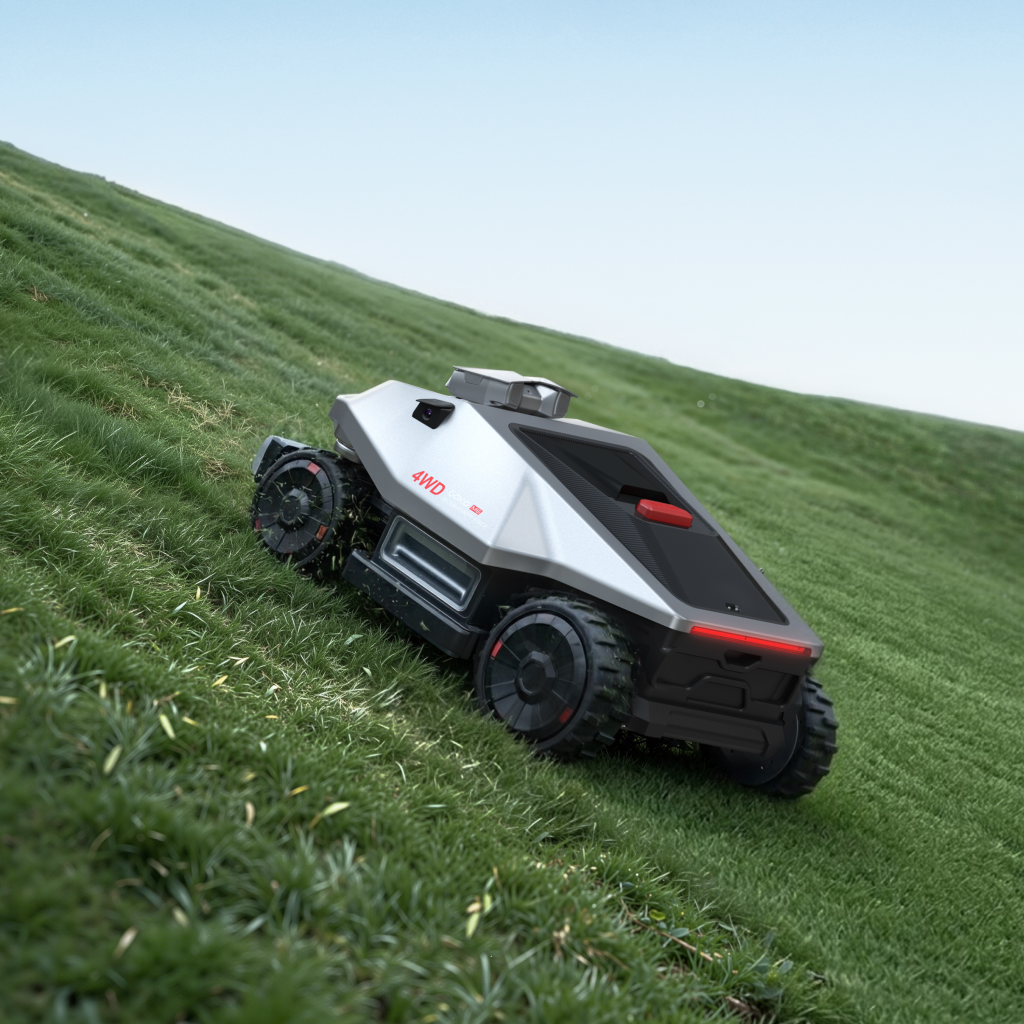
The GoKo Lawn Mower M6 was explicitly engineered for challenging terrain. Its 4-Wheel Drive (4WD) system handles slopes up to 42° (90% gradient) — one of the steepest ratings in the consumer robotic mower category. Combined with adaptive suspension that glides over 3-inch (7.5 cm) obstacles and independent dual front-wheel steering for turf-friendly turning, it performs on surfaces — steep, bumpy, rocky, gravel — where most competitors simply stop or get stuck.
For homeowners with rolling hills, drainage berms, or sloped backyards, this level of terrain capability is not a luxury — it’s a necessity.
Factor 3: Navigation Technology
Navigation is where robotic lawn mowers have evolved the most dramatically in recent years. There are three main systems you’ll encounter:
Perimeter Wire (Legacy)
The original approach: you bury a physical boundary wire around your lawn, and the robot stays within it. It works, but installation is labor-intensive, wires can break or shift, and the system can’t adapt to complex zones intelligently.
Vision/Camera-Based (VSLAM)
Visual Simultaneous Localization and Mapping uses onboard cameras to build a map of the environment. More flexible than wire, but performance can degrade in low light or rain.
RTK GPS / Multi-Sensor Fusion (Best-in-Class)
Real-Time Kinematic (RTK) GPS fuses satellite positioning with additional sensor data for centimeter-level accuracy. Combined with IMU (Inertial Measurement Unit) and wheel odometry, this delivers the most reliable, wire-free navigation available — even in shaded or enclosed yards where standard GPS signal degrades.
What to look for: Wire-free setup, multi-zone support, real-time app mapping, obstacle avoidance with specific object recognition (not just bump sensors).
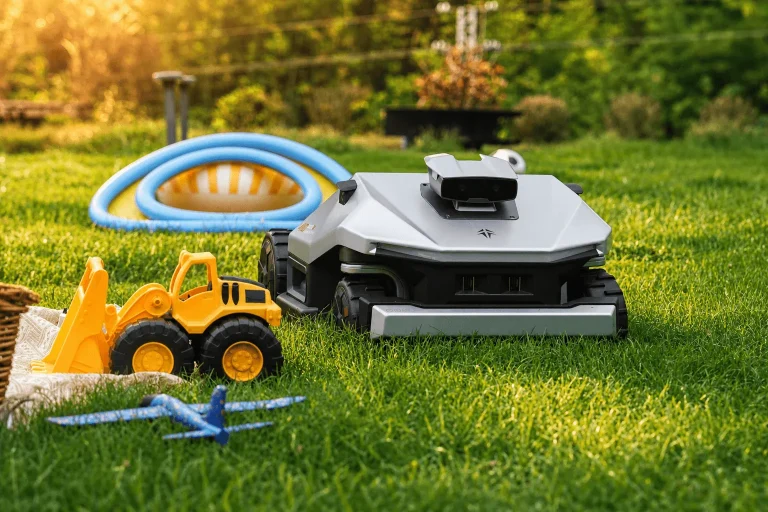
The GOKO M6 uses CyberNav™ Fusion Technology, combining RTK, VSLAM, IMU, and wheel tracking into a single unified navigation stack. This is the same multi-sensor approach used in industrial autonomous vehicles. The system stores maps for up to 15 acres (60,000 m²) and supports unlimited mowing zones. Its AI-Powered QuadVision system uses four cameras and an AI model trained to recognize over 200 object types — from children and pets to garden chairs and sprinkler heads — ensuring safe, uninterrupted autonomous operation.
If navigation reliability is your top priority, this architecture represents the current frontier of what’s possible in a consumer best robot lawn mower.
Factor 4: Battery Life & Runtime
Battery performance is the heartbeat of any electric lawn mower robot. Key metrics to evaluate:
- Max runtime per charge — How long does it mow before returning to the dock?
- Charging time — How quickly does it recharge between sessions?
- Coverage per charge — Actual area covered (more relevant than raw runtime minutes)
- Expandability — Can you add a second battery to extend sessions?
Runtime Benchmarks by Category
| Category | Typical Runtime | Typical Coverage/Charge |
| Entry-level | 60–90 min | 500–1,000 m² |
| Mid-range | 90–150 min | 1,000–2,000 m² |
| Premium | 120–240 min | 2,000–4,000 m² |
The GoKo Lawn Mower M6 delivers up to 120 minutes of mowing time on the standard battery, covering up to 2,000 m² (0.5 acres) per charge. With the optional extended battery, runtime extends to 240 minutes and coverage doubles to 4,000 m² (1 acre) per charge.
Charging is also exceptionally fast: from 20% to 80% in just 50 minutes (single battery) or 90 minutes (extended battery), minimizing downtime during peak mowing days.
For large-property owners, this combination of high capacity and fast charging is a genuine differentiator versus competitors that require overnight charging cycles.
Factor 5: Budget — What Should You Expect to Pay?
The robotic lawn mower market spans a surprisingly wide price range. Here’s an honest breakdown:
Budget Tier: Under $1000
Entry-level models from brands like Worx or older Husqvarna Automower lines. These handle small flat lawns well, often require perimeter wire installation, and have limited smart features. Good for first-time buyers with simple yards.
Mid-Range Tier: $1500–$2,500
Where most consumers end up. Models at this price point often include app control, better slope handling, and wire-free options. Brands like Mammotion LUBA and some Segway Navimow models compete here.
Premium Tier: $3,000+
Purpose-built machines for large, complex, or sloped properties. AI navigation, 4WD, long runtime, multi-zone management, and professional-grade build quality. This is where the best robotic lawn mower contenders compete seriously.
Value tip: Don’t just compare sticker prices — factor in installation costs (wire-based models often require professional installation at $150–$400), annual subscription fees for navigation services, and warranty scope. GoKo includes 1 year of complimentary NRTK service for early backers and a 2-year limited warranty covering the main unit and core components.
Factor 6: Brand Trust & After-Sales Support
Buying a robotic mower is not a one-time transaction. Firmware updates, blade replacements, warranty claims, and app support will be part of your ownership experience for years. Brand credibility matters.
What to Evaluate
- Company history and engineering background: Is this a brand new startup with no track record, or does it have demonstrable robotics expertise?
- Transparent warranty terms: Is the warranty clear, reasonable, and backed by accessible support?
- Parts availability: Can you easily replace blades, batteries, and charging dock components?
- Community and support ecosystem: Active user community? Responsive customer service?
GOKO is the consumer robotics brand of Robot++, a company with over a decade of experience building robots for high-risk surface operations in industrial contexts. This is not a generic white-label product — the M6 reflects genuine engineering investment, including a public debut at CES 2026, where it was showcased to global media, industry analysts, and technology partners.
How GoKo Lawn Mower Stacks Up Against the Competition
Here’s a side-by-side view of how the GOKO M6 compares to other leading models in the best robot lawn mower category across the six buying factors:
| Factor | GOKO M6 | Typical Premium Competitor |
| Max Lawn Size | 2.5 acres (recommended) | 0.5–1.25 acres |
| Slope Handling | 42° / 90% grade | 25°–35° |
| Navigation | nRTK + VSLAM + IMU fusion | RTK or Vision (not both) |
| Runtime (max) | 240 min (expandable) | 120–180 min |
| Map Storage | 15 acres / 60,000 m² | 1,250–5,000 m² |
| Obstacle Recognition | 200+ object types (AI) | Basic bump/ultrasonic |
| Starting Price | $2,599–$2,799 | $3,000+ |
| Warranty | 2 years | 1–2 years |
For buyers with large, sloped, or complex lawns, the GOKO M6 GoKo Lawn Mower represents an unusually complete solution at a competitive price point.
Final Verdict: Who Should Buy What?
Buy the GoKo Lawn Mower M6 if: You own a large property (up to 2.5 acres), deal with steep slopes, rough terrain, or a complex multi-zone layout, and want the most advanced navigation and terrain-handling technology available in the consumer market today.
FAQs
What lawn sizes is the GOKO M6 suitable for?
The GOKO M6 is designed for medium to large estates, covering properties from 0.25 to 2.5 acres (1,000–10,000 m²).
My yard is bumpy, rocky, and has steep inclines. Can the GOKO M6 handle it?
Absolutely. The GOKO M6 is explicitly engineered for challenging terrains that stop traditional smart mowers. It features a powerful 4-Wheel Drive (4WD) system capable of conquering slopes up to 42° (90% gradient), far exceeding the industry average of 25°–35°.
Does the GOKO M6 require a perimeter wire? How does it navigate?
No perimeter wire is required! The GOKO M6 utilizes CyberNav™ Fusion Technology, completely eliminating the need to bury messy physical boundaries.
How large of a map can the mower store, and does it support multiple zones?
The GOKO M6 features an industry-leading map storage capacity of up to 15 acres (60,000 m²) and supports unlimited mowing zones. Through the companion app, you can easily set up boundaries, define specific cutting schedules for different areas, and manage multi-zone properties seamlessly.