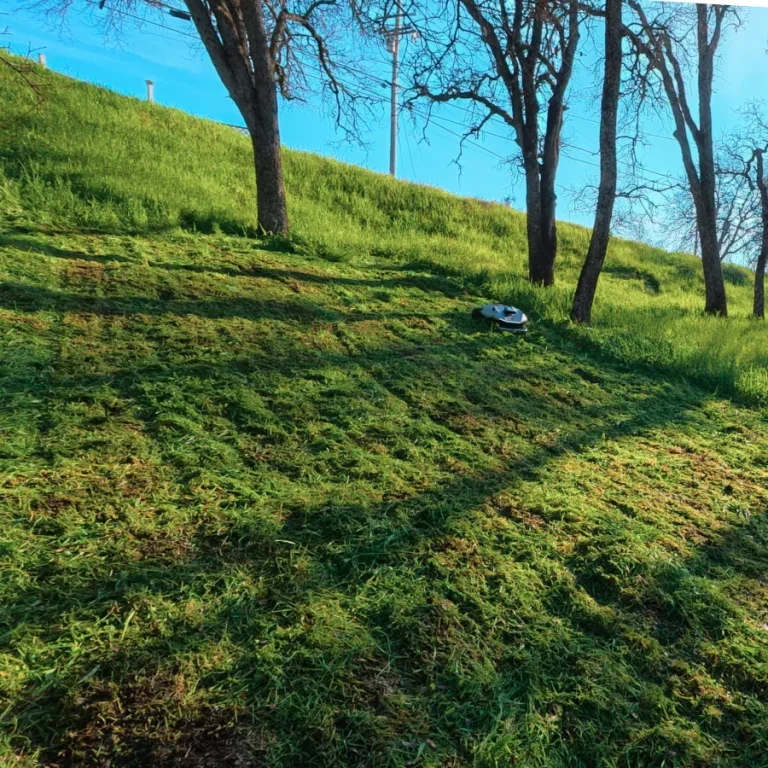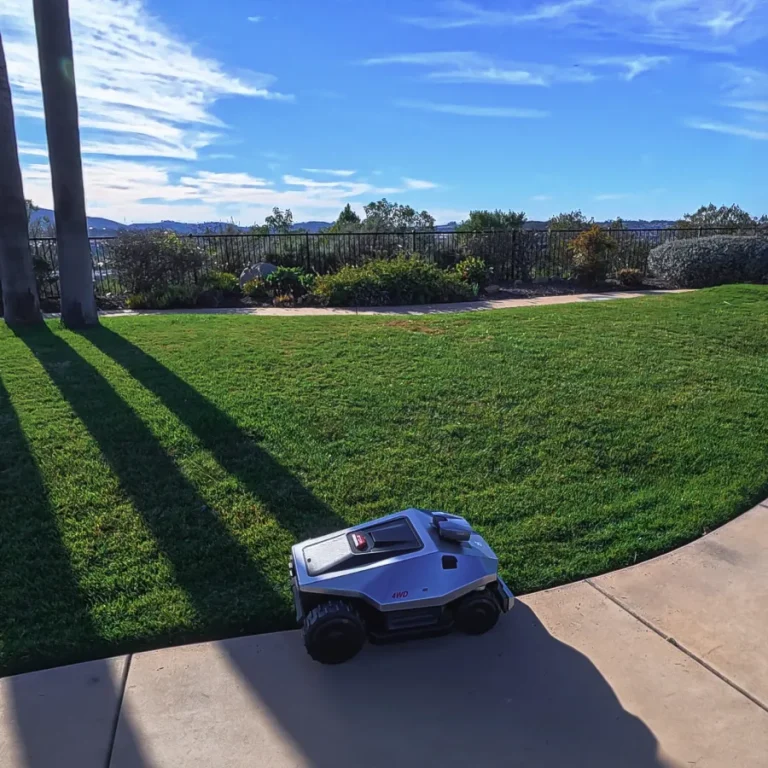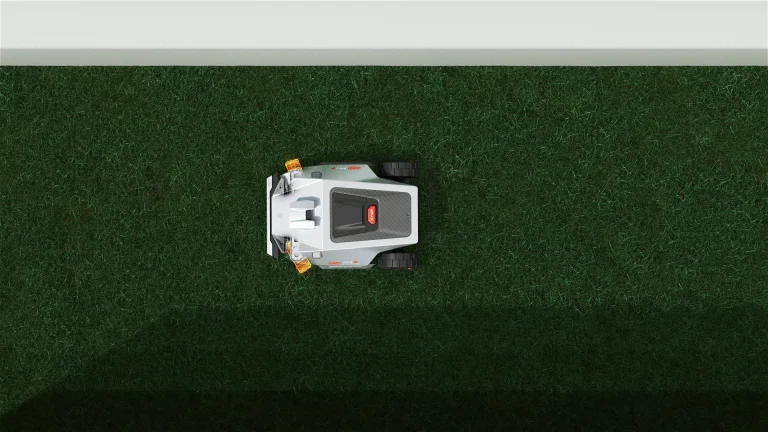
Picture this: you’ve just dropped $2,000+ on a “powerful” robot mower, only to watch it spin its wheels halfway up your backyard slope, dragging a rut across your freshly seeded grass. The problem wasn’t the blade. It wasn’t the battery. It was the drive system — and almost no one talks about this before buying.
If you own a large or complex property, the single most consequential spec in any autonomous lawn mower isn’t its cutting width or its app. It’s how that machine moves across the ground. And in 2025–2026, there are now four meaningful drive architectures competing for your attention: rear-wheel drive (RWD), all-wheel drive (AWD), four-wheel drive (4WD), and tracked drive. Plus one emerging architecture that changes the game entirely — independent active steering, as implemented in the GoKo M6.
This guide cuts through the marketing and gives you a real, engineering-level comparison of each approach.

Drive System: What Actually Happens Under the Mower
Before comparing, it’s worth nailing down some definitions — because the lawn care industry uses “AWD” and “4WD” almost interchangeably, which they are not.
RWD (Rear-Wheel Drive): Power goes only to the rear two wheels. The front wheels steer. Works fine on flat terrain; loses grip on wet or steep ground because weight shifts away from the drive wheels.
AWD (All-Wheel Drive): All four wheels receive power, but torque is distributed dynamically — often biasing toward whichever wheels have more traction. Common in higher-end robot mowers. Better on slopes and slippery ground than RWD.
4WD (Four-Wheel Drive): Power is delivered equally to all four wheels, typically through independent motors. Unlike AWD, 4WD systems don’t necessarily redistribute torque dynamically — they simply ensure all wheels are always driven. This is the architecture used by most premium terrain-focused robot mowers, including the GoKo M6.
Track Drive (Crawler): Instead of wheels, tank-style rubber or metal tracks contact the ground. Maximum traction and obstacle clearance, but significant trade-offs in speed, efficiency, and turf damage.
The steering mechanism is equally important but far less discussed. Most drive configurations pair powered wheels with a passive or pivot-based steering approach — and that’s exactly where many mowers fall short on complex terrain.
Track Drive: The Brute-Force Option
Track-drive robot mowers are the off-road tanks of the autonomous mowing world. Research data from mobile robotics engineering shows that tracked platforms can climb steeper grades than wheeled equivalents and can cross obstacles 60–100% taller than those that wheeled robots manage. On soft surfaces — sand, mud, loose soil — tracked platforms go where wheels sink and stall.
So why don’t we all use track-drive robot mowers?
Three reasons:
1. Turf damage. Tracked systems steer by applying differential braking — slowing or stopping one track while driving the other. This scrubbing motion grinds the surface underfoot. On a lawn, that means torn grass, soil displacement, and visible scarring at every turning point.
2. Speed. Tracked robots typically operate at 0.5–1.5 m/s. Wheeled robots run at 1.5–2.5 m/s. On a 1-acre property, that difference compounds into significantly longer mowing cycles.
3. Energy efficiency. The increased ground contact area of a track system creates higher rolling resistance, draining batteries faster for the same coverage distance.
For a construction site or agricultural field, tracks make sense. For a residential or estate lawn where appearance matters, they’re a poor fit.
AWD and Standard 4WD: A Solid Foundation with One Critical Gap
The shift from RWD to AWD or 4WD robot mowers is meaningful. According to Husqvarna’s engineering documentation, all-wheel drive meaningfully increases performance security on uneven, wet, and slippery surfaces. The physics are straightforward: more powered wheels mean fewer opportunities for the mower to lose traction at any one contact point.
Top AWD autonomous lawn mowers like the Mammotion LUBA 2 AWD and Ambrogio 4.0 Elite RTK 4WD have demonstrated slope-handling capability up to 80% grade (approximately 38.6°) in real-world testing — a significant jump from the 20–30° limits typical of RWD machines.
However, standard AWD and 4WD systems share a common limitation: steering is still achieved by differentiating wheel speed, not by physically turning the front wheels. This “skid steering” approach works — but it has consequences:
- Turning creates lateral scrubbing forces that tear grass fibers
- Turning radius is constrained by the wheelbase
- On slopes, skid steering can cause the mower to drift sideways, reducing both safety and cut-line accuracy
- Power is wasted overcoming the scrub friction at every turn
For a robot mower for uneven terrain that also needs to deliver pristine cut quality on a large estate lawn, standard AWD and 4WD get you 80% of the way there. The last 20% requires a different approach to steering.
GoKo M6: Where 4WD Meets Independent Front-Wheel Steering
The GoKo M6 is built by GOKO, the consumer robotics arm of Robot++, a company with over a decade of experience designing robots for high-risk surface operations. That industrial pedigree shows up directly in the M6’s drive architecture.
The GoKo M6 runs a true 4WD powertrain — all four wheels are driven. But crucially, it pairs that with dual independent front-wheel steering, a mechanism that physically pivots the front wheels to execute turns, exactly like a proper automotive steering system. This combination is rare in the all wheel drive lawn mower category and it solves the core problem that plagues every skid-steer alternative.
What This Means in Practice
On slopes up to 42° (90% grade): Four driven wheels deliver consistent traction, preventing wheel spin or slippage even on the steepest residential inclines. The GoKo M6 handles this grade without slowing — a benchmark that outperforms most competitors in its class.
On rough or bumpy terrain: The M6’s adaptive suspension system absorbs obstacles up to 3 inches (7.5 cm) in height, keeping the floating cutting deck level even when the chassis rocks. This translates to an even cut height across bumpy ground — something neither track-drive nor rigid-chassis 4WD machines can guarantee.
During turns: Because the front wheels steer by rotating on their axis rather than through differential braking, the M6 turns with minimal lateral force on the grass. The result is agile, precise cornering that protects turf integrity and reduces the time spent on direction changes. GOKO describes this explicitly as reducing turf damage, improving coverage, and saving mowing time — and the engineering supports those claims.
Side-by-Side: How the Drive Systems Stack Up
| Criterion | RWD | AWD/4WD (Skid Steer) | Track Drive | GoKo M6 (4WD + Active Steering) |
| Max slope handling | ~25–30° | ~38–42° | ~34° | 42° (90%) |
| Obstacle clearance | Low | Moderate | High | 75 mm |
| Turf damage at turns | Low | Moderate | High | Over 90% reduction in damage |
| Mowing speed | Moderate | Moderate | Slow | 0.4–1.0 m/s |
| Cut quality on uneven ground | Poor | Moderate | Moderate | 25–100 mm(floating deck) |
| Energy efficiency | High | Moderate | Low | MoScalable dual-battery architecture |
| Suitable for estate/residential lawns | Flat only | Yes | Limited | 0.25 to 2.5 acres |
The GoKo M6 occupies a distinct position: it matches or exceeds AWD competitors on slope handling, dramatically outperforms track-drive on turf care and speed, and uniquely combines these with active steering that no skid-steer architecture can replicate.
The Full Autonomous Package: Not Just Drive, But Intelligence
A drive system is only as good as the navigation layer directing it. As a fully autonomous lawn mower, the GoKo M6 pairs its terrain-capable chassis with GOKO’s CyberNav™ fusion navigation, combining RTK satellite positioning, Visual SLAM (VSLAM), IMU sensor data, and wheel odometry for centimeter-level accuracy without any perimeter wire installation.
For obstacle avoidance, the M6 uses a quad-vision AI system with four cameras that recognize over 200 object types — from pets and furniture to toys and garden hoses — adjusting its path in real time without stopping the mowing session unnecessarily.
The result is an autonomous lawn mower that doesn’t just survive complex terrain — it navigates it intelligently, mapping up to 15 acres of property across unlimited mowing zones, and managing every session through a dedicated app or voice commands via Google Home and Alexa.
Who Is the GoKo M6 Actually For?
The GoKo M6 is clearly engineered for property owners whose terrain has ruled out conventional robot mowers. Specifically:
- Properties with steep slopes (35°+) where standard mowers slip or tip
- Large lawns (0.25 to 2.5 acres) where cut quality needs to stay consistent across variable terrain
- Owners who want zero perimeter wire installation and full autonomous scheduling
- Anyone who has already damaged turf with a track-drive or skid-steer machine and needs a gentler alternative
Final Verdict: Drive Architecture Is the Purchase Decision
Most buyers compare robot mowers on cutting width, battery runtime, and app features. Those specs matter. But if your property has slopes, bumps, gravel edges, or drainage swales, the drive system is the spec that will determine whether your mower completes the job or gets stuck halfway through it.
Track drive gives you brute-force traction but tears turf. Standard AWD gives you good slope performance but struggles with turn quality on complex terrain. The GoKo M6 brings something different to the table: true 4WD traction combined with independent active steering and adaptive suspension — a combination that handles the ground beneath it without compromising the lawn above it.
For owners who’ve been waiting for an all wheel drive lawn mower that’s genuinely designed around terrain complexity rather than just marketed that way, the GoKo M6 is the most technically credible answer available in 2025–2026.
FAQs
1. Why is the drive system more important than other specs?
Battery and blade size don’t matter if your mower gets stuck. On complex yards with slopes, wet grass, or ruts, the drive system determines whether the machine actually finishes the job or stalls and spins its wheels.
2. How does the GoKo M6’s steering protect the lawn?
Most AWD mowers use “skid steering” (slowing one side to turn), which grinds and rips the grass. The GoKo M6 features independent active front-wheel steering that physically pivots like a car, delivering precise turns with virtually zero turf damage.
3. How does it handle extreme 42° (90%) slopes?
It pairs a true 4WD powertrain (all four wheels are independently driven) with an adaptive suspension system. This keeps all wheels firmly planted on the ground, preventing slippage even on steep inclines.
4. Is a track-drive (crawler) mower better for tough terrain?
Tracks offer high traction but tear up lawns during turns, drain batteries faster, and move slowly. The GoKo M6 matches track-level slope capability (42°) but uses a wheeled design that protects your grass.
5. Does the GoKo M6 require boundary wires?
No, it is 100% wire-free. It uses CyberNav™ Fusion Navigation (combining RTK satellite, VSLAM cameras, and sensors) to map up to 15 acres and navigate complex yards with centimeter-level accuracy.