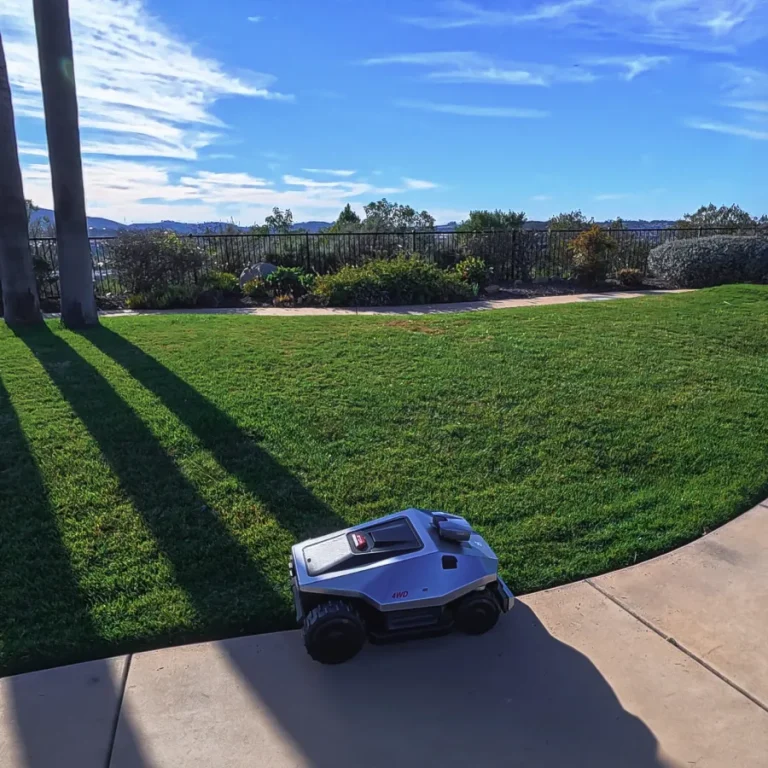
Picture the yard that breaks robot mowers. A back lawn that pitches up at an angle steep enough to make you plant your feet sideways. A gravel strip where the grass gives way to loose stone. Tree roots breaking the surface near the fence line, a garden hose someone forgot to coil, a child’s toy half-hidden in the long grass, and the whole thing sprawling across the better part of two acres. Most “smart” mowers meet a yard like this and quietly give up — spinning out on the grade, beaching on a root, or wandering off the map. The GoKo M6 was designed for exactly this scene, and the technology that makes it possible is worth understanding in detail.
Navigation that doesn’t need a wire
The first thing that makes a modern robot mower genuinely “smart” is how it knows where it is. Older systems relied on a buried perimeter wire — a weekend of trenching before the machine cut a single blade. The GoKo M6 skips that entirely with CyberNav, a fusion navigation system that blends several positioning sources rather than trusting any one.
CyberNav combines RTK satellite positioning, VSLAM (vision-based simultaneous localization and mapping), an inertial measurement unit, and wheel tracking. The reason this matters is redundancy: RTK delivers centimeter-level accuracy under open sky but can struggle near heavy tree canopy, where vision and inertial data pick up the slack. By fusing them, the mower stays located across the awkward transitions — open turf to shaded pocket to narrow side passage — that confuse single-sensor machines. It supports both Network RTK and Local RTK, so the setup can be tuned to different yard environments, and it stores maps for properties up to 15 acres across an unlimited number of zones. You draw boundaries in the app instead of in the soil.
Eyes on the lawn: AI QuadVision
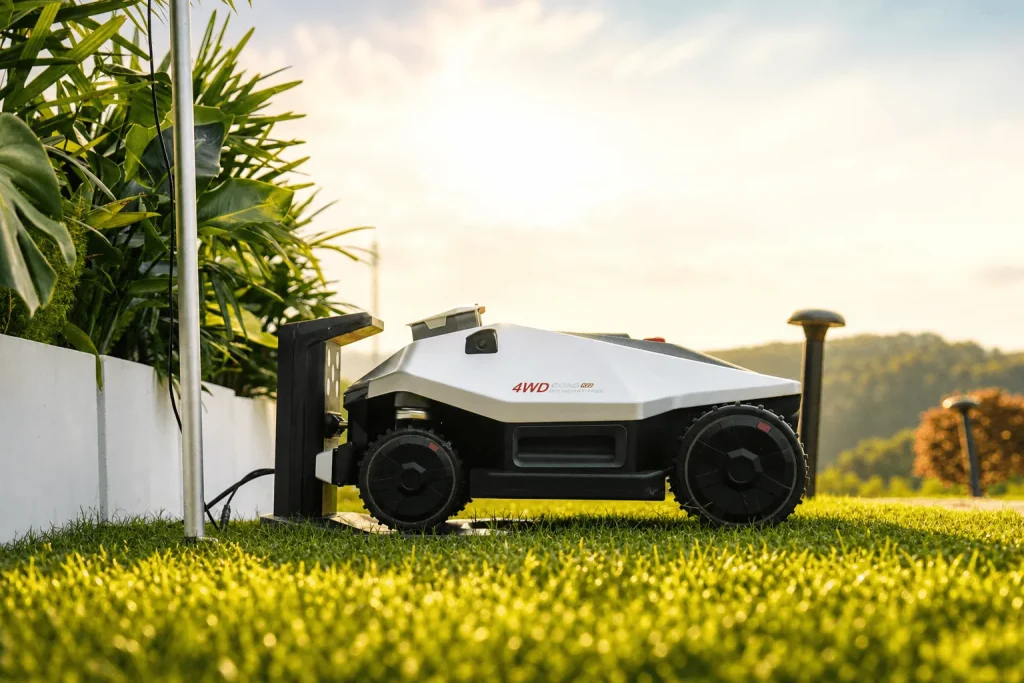
Knowing where it is solves only half the problem. A smart lawn mower also has to understand what is in front of it, in real time, and react. The GoKo M6 handles this with QuadVision, an AI vision system built around four cameras, with side-view cameras added for better peripheral awareness and cleaner edge cutting.
The system is trained to recognize more than 200 categories of object — people, pets, toys, furniture, and the assorted obstacles that accumulate on a lived-in lawn. Rather than bumping into things and reversing, it identifies and avoids them, which keeps mowing continuous and, more importantly, keeps it safe around the family and the dog. The side cameras also help it work tighter spaces and trace edges more precisely, so the finished cut looks intentional rather than approximate. This is the difference between a machine that merely moves and one that perceives.
A drivetrain built like a small off-road vehicle
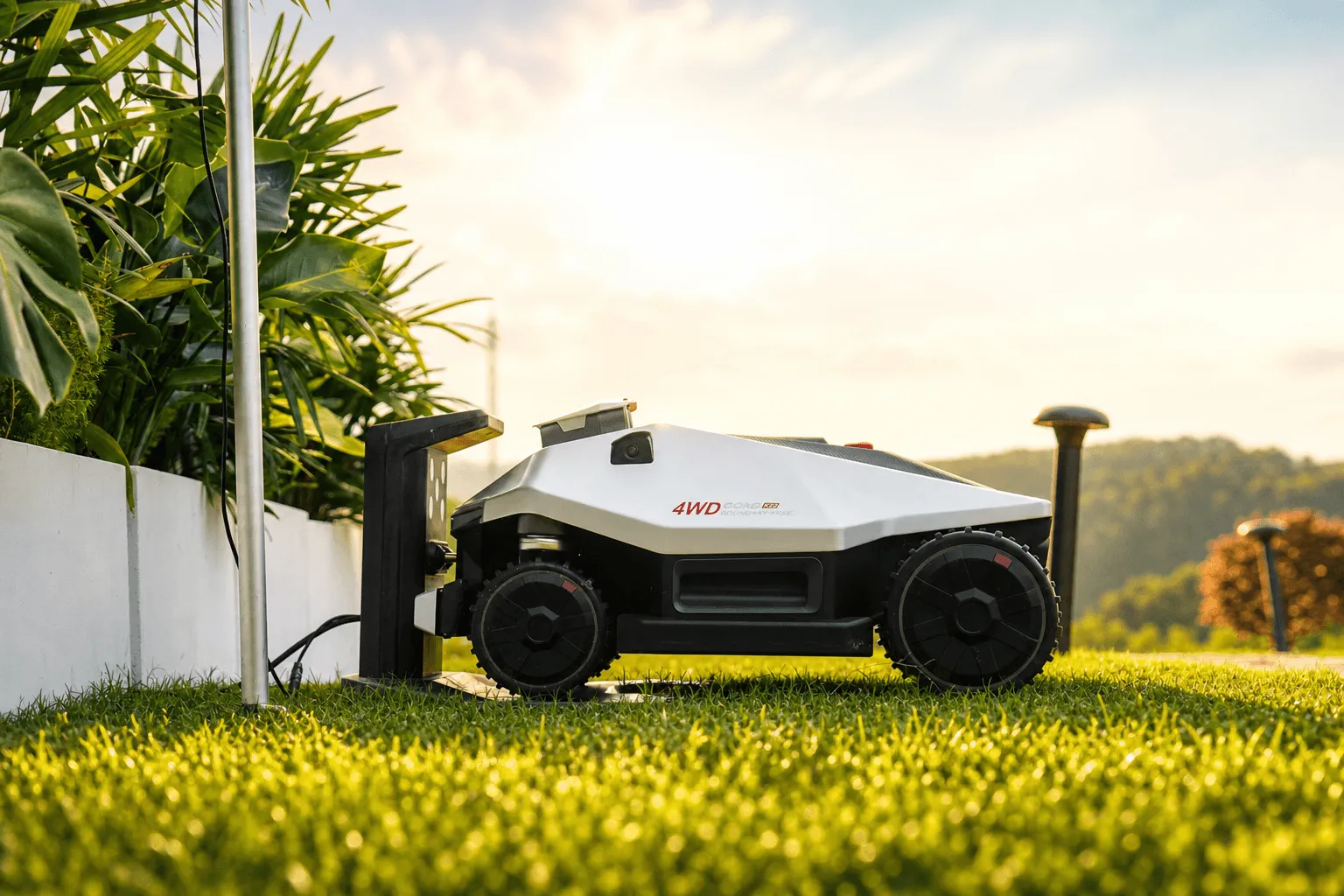
Perception and navigation are wasted if the hardware can’t follow through on rough ground, and this is where the GoKo M6 most clearly departs from the flat-lawn crowd. Its chassis behaves less like a tidy disc and more like a compact all-terrain vehicle.
Four-wheel drive paired with adaptive suspension lets it climb slopes up to 42 degrees — a 90% grade — without slipping or stalling, while keeping all four wheels planted for a steady cut. The suspension glides over obstacles up to about 3 inches (75 mm) high, the tree roots, ruts, and drainage edges that stop lesser robots, and a smart recovery system helps it free itself from mud or loose ground without someone trudging out to rescue it.
Just as important is how it turns. Many robotic mowers steer like a skid-steer, pivoting by dragging their wheels across the grass, which scuffs and tears the lawn over time. The GoKo M6 uses dual independent front-wheel steering instead, turning on actual steered wheels to reduce dragging, scuffing, and rut formation. It also varies its routes and cutting angles over time, which helps prevent the repetitive wheel tracks and matted lines that betray a robot’s presence — a small touch that adds up to a more natural, uniform lawn.
Cutting performance for serious grass
A premium drivetrain still has to mow well, and the GoKo M6’s cutting system is sized for demanding turf rather than a manicured patch. A 16.5-inch (420 mm) floating deck covers more ground per pass and follows the contours of the ground to keep the cut even, delivering the clean, carpet-like finish and crisp stripes you would expect from professional equipment.
Underneath, a blade spinning at 5,000 RPM with up to 1,500 W of peak output supplies the muscle for thick, dense, or fast-growing grass. The deck accepts two swappable blade systems — razor discs or rotary mulching blades — so the machine can be matched to the lawn rather than forcing one approach onto every grass type. Cutting height adjusts from 1 to 4 inches (25–100 mm). And because it mulches with frequent shallow cuts, the fine clippings break down quickly and feed the turf, the same mechanism that tends to leave robot-mowed lawns looking denser and greener over a few weeks of regular use.
Living with a smart lawn mower
The best robotic lawn mower is one you can forget about, and the GoKo M6’s day-to-day experience is built around that. Through the app you set mowing zones, cutting height, stripe angle, and schedules, track each session, and receive instant notifications. An onboard 4.3-inch color touchscreen with a tactile control knob handles quick adjustments at the machine, and voice control works through Google Home and Alexa for hands-free commands.
Practical resilience is part of the package, too. Rain detection lets it respond to weather, an IPX6 water-resistance rating means it isn’t fazed by a wet lawn, and a multi-layer security suite — GPS tracking, ownership authentication, geo-fence alerts, and off-ground alerts — protects a machine that, by definition, spends its life outdoors and unattended. Connectivity spans 4G, Wi-Fi, and Bluetooth, so it stays manageable whether or not you are home.
What makes the GoKo M6 a genuinely smart lawn mower isn’t a single headline feature; it’s the way navigation, perception, drivetrain, and cutting are engineered to work together on terrain that ordinary robots avoid. Fusion positioning keeps it oriented, AI vision keeps it aware, four-wheel drive and steered turning keep it moving without wrecking the turf, and a powerful, adaptable deck finishes the job. For the difficult yard described at the top of this piece — the one with slopes, roots, and acres — that integrated approach is the whole point.
FAQs
What makes the GoKo M6 a “smart” lawn mower?
It fuses RTK, vision (VSLAM), inertial, and wheel-tracking navigation with an AI camera system that recognizes 200-plus objects, then adds app and voice control, scheduling, and security features for largely hands-off operation.
Can the GoKo M6 handle steep slopes and large yards?
Yes. It is rated to climb 42-degree (90%) slopes with four-wheel drive and adaptive suspension, clears 3-inch obstacles, and is recommended for lawns up to roughly 2.5 acres, with map storage for up to 15 acres.
Does the GoKo M6 need a boundary wire?
No. It uses wire-free CyberNav fusion navigation, so boundaries and zones are configured in the app rather than by burying perimeter cable.