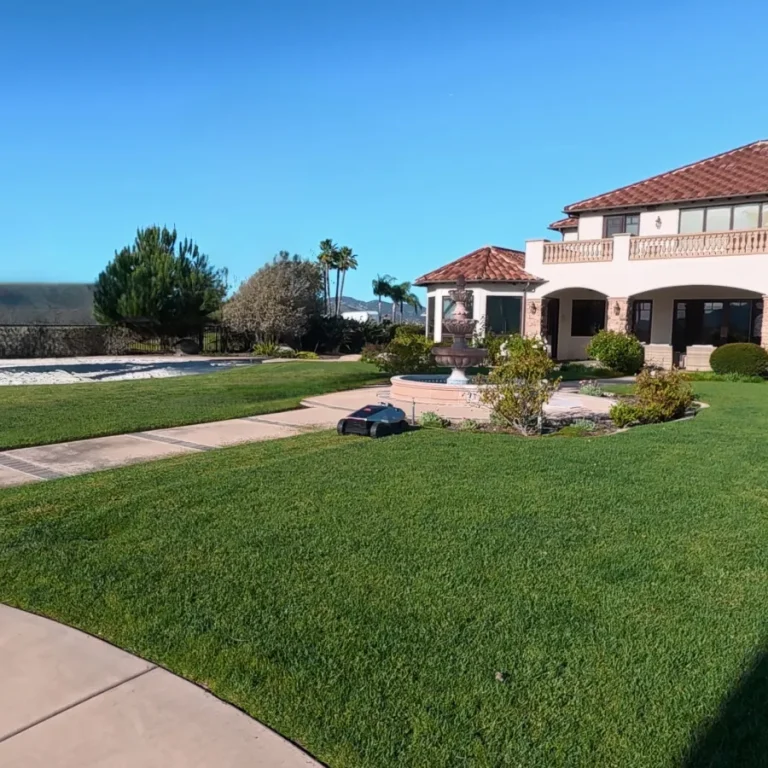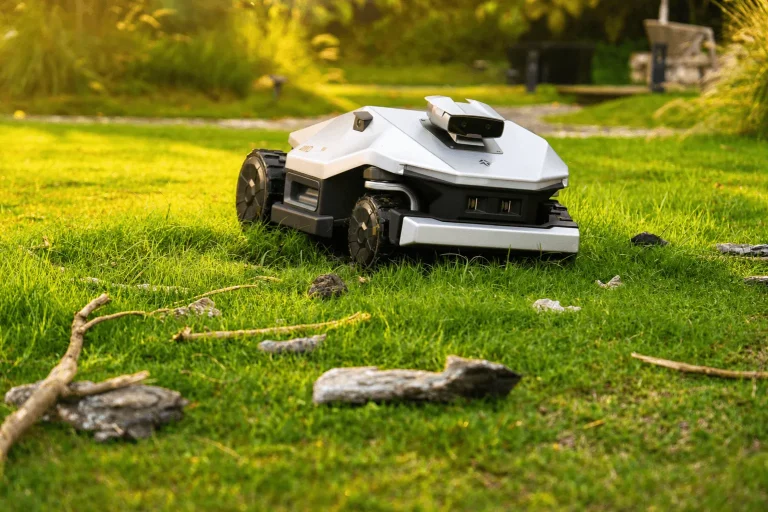
Drive into a tunnel and your phone barely misses a beat. The instant GPS drops, it leans on motion sensors — the same accelerometer and gyroscope that count your steps — and keeps estimating where you are until the satellites come back. You never notice the handoff. That trick has a name, sensor fusion, and it’s the exact reason a modern wire free robot lawn mower can roam an entire yard without a single inch of buried cable. Because once you take the boundary wire away, the whole challenge of robot mowing collapses into one question: how does the machine know where it is? The GoKo Lawn Mower answers it the same way your phone does — not with one sensor, but with several working together. Here’s how that works, and why it matters more than any spec on the box.
The wire was always the weak link
For two decades, “boundary” meant a literal wire. You trenched a loop around the entire lawn, pinned or buried it, and the mower bounced off the signal like a bumper car. It worked, but the wire was the part that aged badly. Installing it was a weekend of spade work. Aerating, edging, or planting a new bed risked nicking it. Frost heave and stray shovels snapped it, and finding the break in a hundred metres of buried cable was its own miserable afternoon. Worst of all, it was rigid: reshape a flowerbed or move the mower to a second lawn, and you were back to laying wire.
The shift to a robot lawn mower no boundary wire didn’t just delete an inconvenience. It moved the entire engineering problem off the lawn and into software — onto positioning.
When the wire disappears, positioning becomes everything
A buried wire was crude but certain: cross it, turn around. Remove it, and the mower suddenly needs to know, at every moment, where the grass ends and the petunias begin — accurately enough to steer a spinning blade past a garden bed. That’s a far harder problem than “am I over the wire?” It demands centimetre-level awareness of position across the whole yard: in open sun and deep shade, on flat stretches and slopes, season after season.
No single sensor delivers that everywhere. Each available technology is brilliant in some conditions and helpless in others. Which is exactly why the GoKo Lawn Mower doesn’t pick one — it fuses three.
The three signals behind GoKo’s fusion positioning
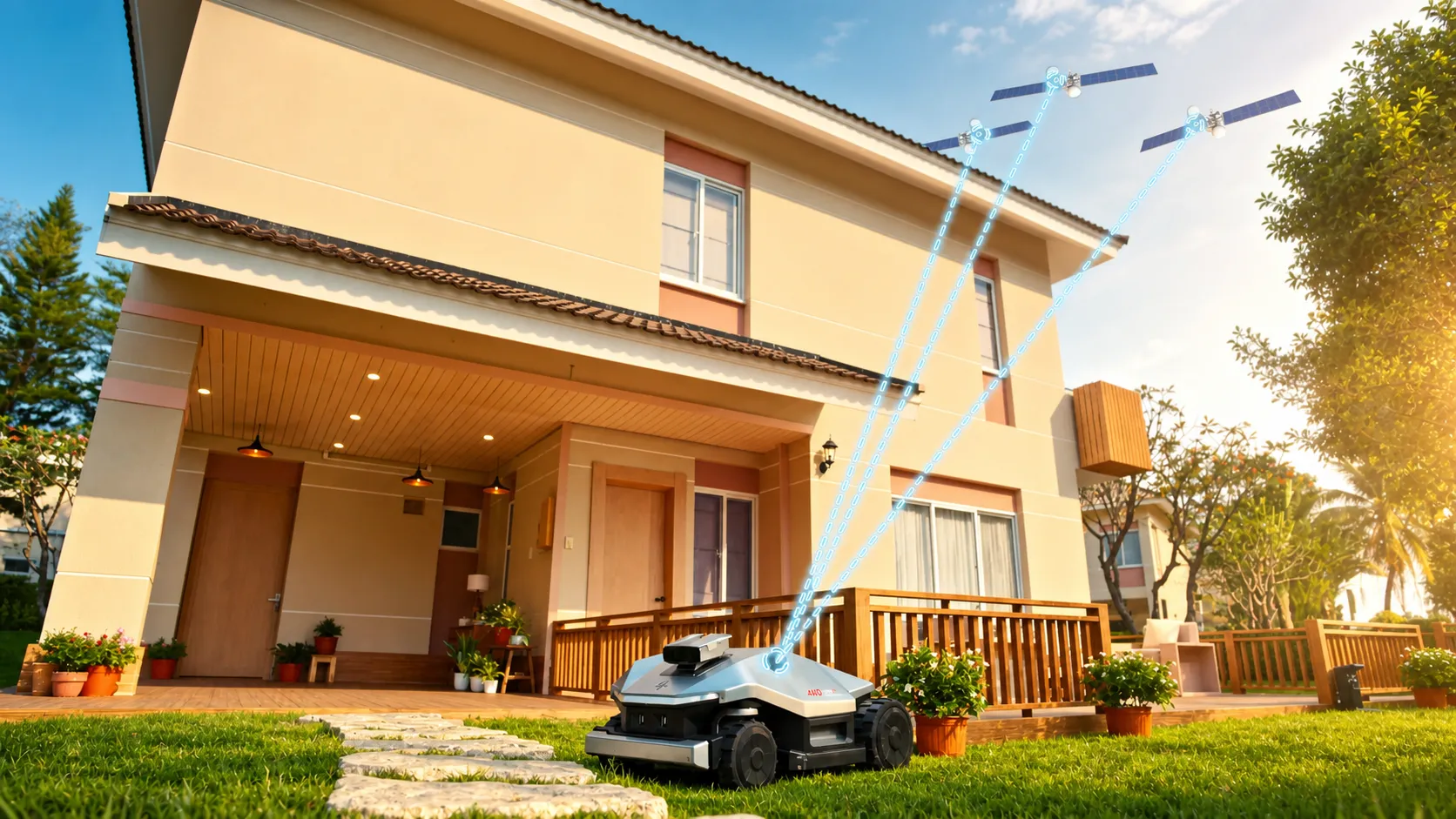
GoKo’s CyberNav system blends RTK satellite positioning, VSLAM visual mapping, and an IMU, with wheel-tracking odometry adding a fourth independent check. The intelligence isn’t in any one sensor; it’s in the blend.
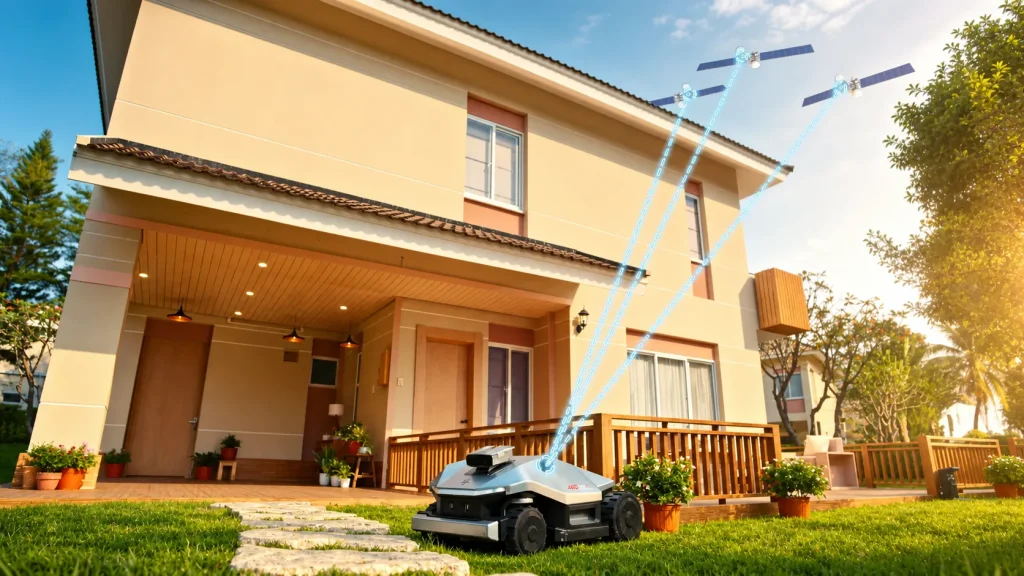
RTK — the global backbone. A standard GPS fix is accurate to a few metres — fine for a map app, useless for threading a blade past a flowerbed. RTK (Real-Time Kinematic) positioning sharpens that to roughly 1–2 centimetres by pairing the raw satellite signal with a live stream of corrections that cancel out timing errors. This is what makes wire-free boundaries possible in the first place: you map the perimeter once, and the mower holds that virtual line. RTK’s honest limitation is the sky. Dense tree canopy, roof eaves, tall fences, and reflective walls can block or bounce the signal — a problem called multipath — and “centimetre accuracy” is really a best-case figure for clear, open sky with a stable signal. When an RTK fix degrades, accuracy slips with it.
VSLAM — local context from cameras. VSLAM (Visual Simultaneous Localization and Mapping) looks around instead of up. It tracks visual features — fence corners, tree trunks, the edge of a patio — from one camera frame to the next, building a local map and pinpointing the mower inside it. Where satellites thin out, vision can still recognise the surroundings, filling precisely the gaps RTK leaves under trees and beside buildings. Its own weakness is light and texture: dusk, glare, and big featureless lawns give it less to grab onto.
IMU — short-term steadiness. An IMU (Inertial Measurement Unit) is the accelerometer-and-gyroscope package that senses motion and orientation directly, with no outside signal at all. When RTK and vision both blink for a moment — slipping under a thick oak, say — the IMU keeps “dead-reckoning” the mower’s path so it doesn’t lurch, stall, or wander. The catch is drift: an IMU is superb over short stretches but quietly accumulates error over time, so it needs RTK or vision to reset it. Wheel-tracking odometry works alongside it, counting wheel rotations to measure how far the mower has actually travelled.
Why fusion beats any single sensor
Line those three up and the logic writes itself: every sensor’s blind spot is another’s strong suit. RTK gives rock-solid global position but falters under canopy. VSLAM sees under that canopy but drifts on bare lawns and in low light. The IMU never loses signal but drifts over time. Run any one of them alone and the mower is flawless in some corners of the yard and unreliable in the next.
Blend them, and the weaknesses cancel out. A shaky RTK fix is propped up by vision; a confused camera is steadied by the IMU; a brief, total signal gap is bridged by inertial and wheel data until the global signal returns. The industry shorthand captures it well: a single-sensor mower fails in the wrong conditions, while a fusion mower keeps working because it always has a backup. That redundancy — RTK as the global reference, vision for local detail, the IMU to smooth the gaps — is the entire point of CyberNav, and it’s what lets the GoKo Lawn Mower stay confident across a messy, real-world yard instead of just an open test field.
What wire-free fusion actually changes for you
Strip away the theory and the payoff is refreshingly practical. With a wire free robot lawn mower, there’s no trench to dig and no cable to slice the next time you aerate, edge, or plant something new. Setup is a walk around the perimeter once in the app, not a weekend with a spade. Boundaries and no-go zones around the pond, the trampoline, and the vegetable patch are drawn and edited in minutes — and because nothing is buried, a robot lawn mower no boundary wire can be picked up and moved, or sent to a second lawn, without re-laying a thing.
That flexibility scales, too. The GoKo Lawn Mower stores large maps and supports multiple mowing zones, and it manages cutting height, stripe angle, and schedules from the app — so the wire-free approach suits big, multi-area properties that a fixed wire loop would struggle to wrap around at all.
FAQ
Is the GoKo Lawn Mower really a robot lawn mower with no boundary wire?
Yes. It’s a fully wire free robot lawn mower — there’s no buried perimeter cable anywhere. You set virtual boundaries and no-go zones in the app, and CyberNav fusion positioning keeps the mower inside them.
Do I need to install an RTK base station?
The GoKo Lawn Mower comes with a complimentary NRTK (Network RTK) service, so the corrections that power its centimetre-level accuracy are delivered over the network through its built-in 4G connection. That removes much of the antenna-mounting hassle some RTK systems require.
Will it still work under trees and along the house?
That’s exactly what fusion positioning is for. Where the satellite signal weakens under canopy or beside a wall, VSLAM and the IMU keep the mower located and on track, so it doesn’t drift or stall the way a satellite-only mower can.
Does “centimetre accuracy” mean it’s flawless everywhere?
Centimetre-level accuracy is a best-case figure for open sky with a stable signal — not a guarantee under heavy foliage or next to reflective surfaces, which is precisely why the GoKo Lawn Mower also leans on vision and inertial sensing. For boundaries near pools, roads, or drop-offs, it’s still smart to leave sensible buffer zones.
The buried boundary wire solved exactly one problem — keeping a mower on the lawn — by creating several others: the install, the repairs, the rigidity. Going wire-free swept all of that away, but only by trading it for a harder problem in software: knowing precisely where the machine is at every single moment. No one sensor can do that across a whole yard, which is why the GoKo Lawn Mower fuses RTK’s global accuracy, VSLAM’s local vision, and an IMU’s steady motion sensing into a single system. The result is what the wire free robot lawn mower era was always reaching for — a mower that knows exactly where it is, with nothing buried in your lawn to prove it.