Under a quarter acre, almost any robotic mower works. The lawn is small, the geometry is simple, and the battery finishes before you’ve noticed it started.
At one acre and above, the marketing stops working and the arithmetic starts. An acre is 43,560 square feet. It has slopes. It probably has a tree line that blocks satellite signal, a driveway splitting the front from the back, and a septic mound the previous owner never mentioned. Buy a robot mower for large yard duty on headline specs alone and you’ll discover the shortfall in July, when the grass is growing three inches a week and your machine is docked for the fourth time before lunch.
This guide is the arithmetic. Six metrics, worked through with real numbers.
Metric 1: Coverage Per Day, Not Coverage Per Charge
This is the single most misread spec in the category.
“Up to 1 acre per charge” sounds like the ceiling. It isn’t — it’s the stride length. A modern mower auto-docks when the battery runs low, recharges, and resumes where it left off. What determines whether your lawn gets finished is the duty cycle: mowing time divided by mowing time plus charging time.
Run the GOKO M6’s published numbers:
| Single Battery (12 Ah) | Dual Battery (24 Ah) | |
| Typical mowing time | ~120 min | ~240 min |
| Charging time (20–80%) | ~45 min | ~90 min |
| Max coverage per charge | 0.5 acre (2,000 m²) | 1 acre (4,000 m²) |
| Max coverage in 12 hours | 1.5 acres (6,000 m²) | 2 acres (8,000 m²) |
Notice what the fourth row does to the third. A single-battery machine that only covers half an acre per charge still clears 1.5 acres in a twelve-hour window — three times its per-charge figure — because it cycles. The per-charge number sells the machine. The twelve-hour number tells you whether your lawn gets cut.
For a robotic mower for 1 acre lawn, that means single-battery capacity is already sufficient on paper. Whether it’s sufficient in practice depends on the next five metrics.
Metric 2: Effective Mowing Rate
Coverage is really just width × speed × time, discounted for overlap and turns. Do it yourself:
- Cutting width: 16.5 in = 1.375 ft
- Mowing speed: 0.9–2.2 mph
At an effective 1.5 mph (a realistic average once turns and overlap are included), that’s 7,920 linear feet per hour × 1.375 ft = ~10,900 ft² per hour, or about a quarter acre. Which is exactly why the M6’s dual battery clears 1 acre (43,560 ft²) in its ~240-minute runtime. The specs are internally consistent — a good sign, and something you should check on any machine you’re comparing.
The lesson: cutting width is a coverage multiplier, not a cosmetic detail. A 12-inch deck at the same speed loses roughly a quarter of the throughput. On a quarter-acre lawn nobody notices. On an acre, that’s an extra hour every session, every week, all season.
Metric 3: Battery Architecture — Expandable Beats Big
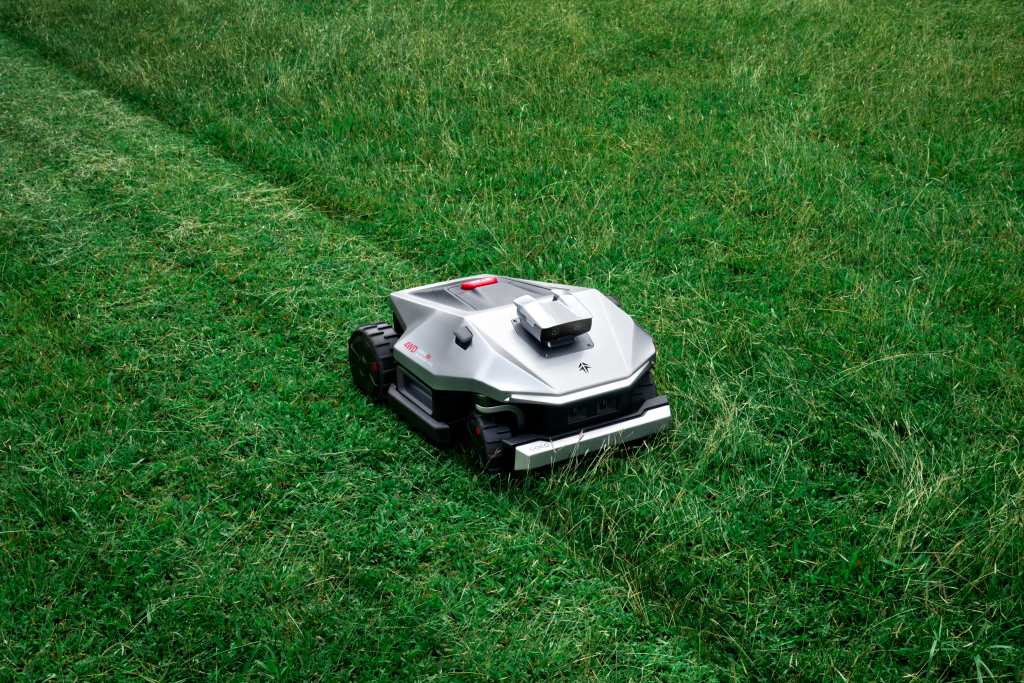
The M6 uses an expandable dual-battery system: start with 12 Ah, add a second battery to double runtime.
Here’s the subtlety. Doubling the battery doesn’t improve the mow-to-charge ratio — both configurations run roughly 2.7 minutes of mowing per minute of charging. What doubling the battery actually buys you on an acre is fewer trips home.
Every dock cycle costs dead-head travel. On a compact lot the mower is never far from the station. On an acre, the far corner might be 200 feet away — so each return, dock, charge, and re-deploy burns real time on grass it isn’t cutting. Halve the number of cycles and you claw that time back. That’s why the coverage gain from 1.5 → 2 acres per 12 hours is smaller than the raw runtime doubling would suggest, and why it still matters.
Metric 4: Capacity Must Beat Growth, Not Just Lawn Size
The mistake: “my lawn is one acre, so I need one acre of capacity.”
The reality: turf agronomy’s one-third rule says never remove more than a third of the blade height in a single cut. Robot mowers honor this by cutting little and often — tiny clippings that mulch invisibly back into the canopy and return nitrogen to the soil.
That means a robot lawn mower for 1 acre shouldn’t be sized to mow the acre once a week. It should be sized to mow it every one to two days during peak growth. Required capacity is lawn size ÷ desired interval:
- 1 acre every 2 days → 0.5 acre/day
- 1 acre every day → 1 acre/day
Both are inside the M6’s envelope. Both would strand a machine sized purely to “one acre, once.”
Metric 5: Multi-Zone Management
Large properties are rarely one shape. Front lawn, back lawn, a strip beside the garage, an orchard.
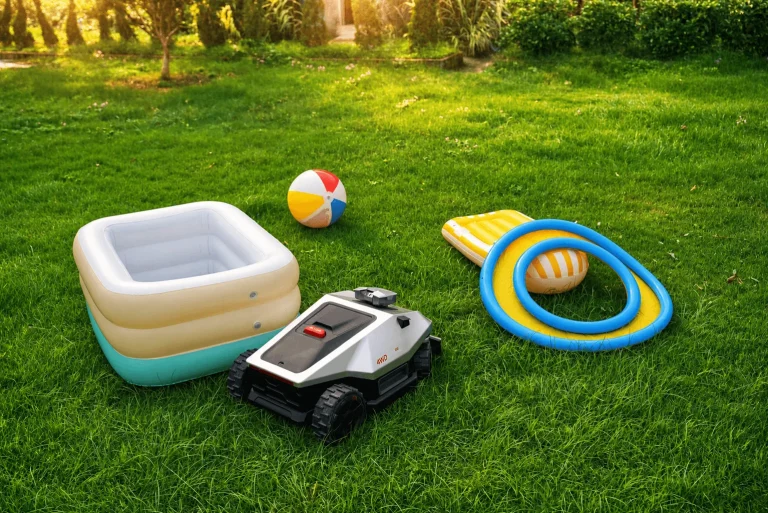
The M6 stores maps for up to 15 acres (60,000 m²) and manages unlimited zones. That headroom matters more than it looks: you’re not just mapping the grass, you’re mapping no-go zones around beds, ponds, trees, and the septic lid, each of which the app lets you draw and edit.
Two honest caveats for large-yard buyers:
- A connecting grass corridor is what lets a mower self-transit between zones. Areas fully separated by a driveway or hardscape generally require you to carry the mower across — a thirty-second job, but not an autonomous one.
- Each zone gets its own schedule. Use this. A shaded back lawn grows slower than a sunny front and shouldn’t be cut on the same cadence.
Metric 6: Positioning Coverage Across the Whole Acre
This is the spec people skip and then regret.
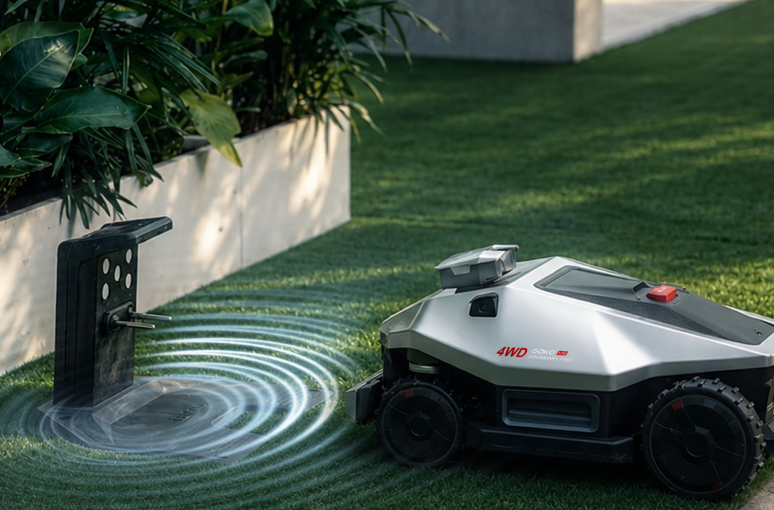
A wire-free mower navigates by RTK correction, which needs satellite visibility. Across an acre with a mature tree line, some fraction of your lawn will have compromised sky view. The question is what the machine does there.
The M6’s CyberNav™ Fusion Navigation blends RTK, nRTK, VSLAM visual navigation, an IMU, and wheel odometry — so a degraded satellite signal under the oaks is carried by vision and inertia rather than stopping the task.
But note the published fallback limit: without RTK, mowing range is capped at roughly 1,600 ft² (150 m²) and 10 minutes. That is a bridge across a shaded pocket, not a substitute for correction coverage. Practical implication: mount the RTK reference station high and with genuine open sky — a roof edge or the clearest corner of the property, not under the canopy you’re trying to compensate for. On a large lot, this single decision determines whether the far third of your lawn gets mowed reliably.
And the Terrain, Because Acres Have More of It
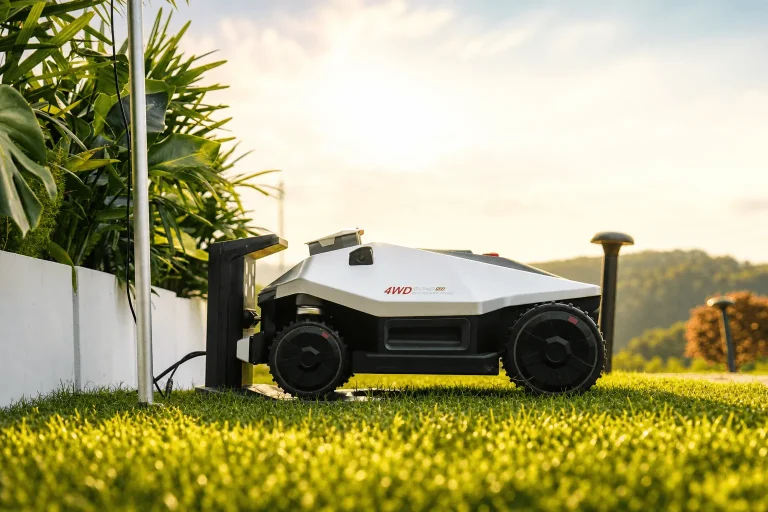
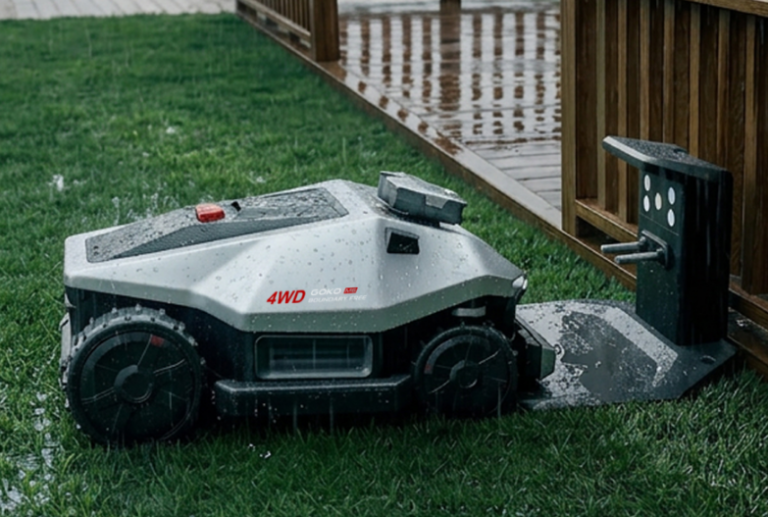
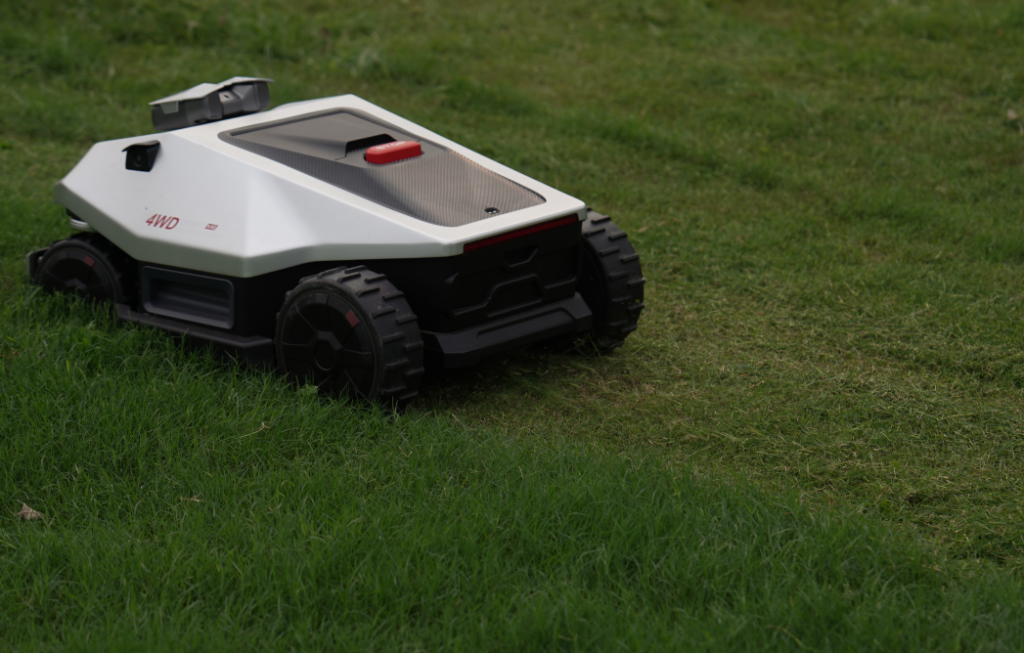
Big properties come with berms, drainage swales, gravel paths, and roots. The M6 handles slopes up to 42° (90%) on 4WD with adaptive suspension, clears 3-inch obstacles, and uses front-wheel active steering to turn tightly with less wheel drag — which, repeated thousands of times across an acre, is the difference between a lawn and a wear pattern. Intelligent path planning varies the mowing pattern each session to keep wheel tracks from compacting into ruts.
Quick Sizing Reference
| Your lawn | Configuration | Why |
| 0.25–0.5 acre | Single battery | One charge, done |
| 0.5–1 acre | Single works; dual is more comfortable | Fewer dock cycles, faster completion |
| 1–2 acres | Dual battery | 2 acres/12 hr headroom, daily cadence viable |
| 2–2.5 acres | Dual battery, tight scheduling | Top of the recommended range |
| Over 2.5 acres | Look at commercial equipment | Outside the M6’s rated envelope |
GOKO rates the M6 for lawns of 0.25–2.5 acres (1,000–10,000 m²). Respect the top of that range. A mower running at 100% of spec every day, all season, is a maintenance problem waiting to happen.
FAQs
Q: Can the GOKO M6 really handle a full acre?
Yes. The dual-battery configuration is rated at 1 acre (4,000 m²) per charge and up to 2 acres (8,000 m²) in a 12-hour window. Even the single-battery version covers 1.5 acres per 12 hours by auto-docking and resuming. The recommended lawn size range is 0.25–2.5 acres.
Q: Do I need the dual battery for a 1-acre lawn?
Not strictly — the single battery clears 1.5 acres per 12 hours. But on an acre, dual battery halves the number of return-to-dock cycles, finishes sooner, and leaves headroom for peak-season growth when you want a daily cadence rather than every other day.
Q: How does a robot mower handle a front yard and back yard separated by a driveway?
Map them as separate zones — the M6 supports unlimited zones and stores up to 15 acres of map data. If there’s a grass corridor connecting them, the mower can transit on its own. If the areas are fully divided by hardscape, plan on carrying it across.
Q: What happens in the shaded parts of a large lot where GPS is weak?
Fusion navigation takes over: VSLAM, IMU, and wheel odometry maintain positioning through low-signal pockets. Be aware, though, that mowing without RTK or nRTK correction is limited to about 1,600 ft² and 10 minutes — so the reference station’s sky view is the thing to get right at installation, not an afterthought.
Finally
A robot mower for large yard use isn’t chosen by reading the biggest number on the box. It’s chosen by dividing: lawn size by mowing interval, coverage by duty cycle, deck width into linear feet per hour.
Do that arithmetic once, before you buy. The machine that survives an acre in August is the one you sized in March.